

Key Takeaways
- Food can account for 25-35% of a family vacation budget when eating out at every meal.
- Booking accommodations with a kitchen or kitchenette is one of the highest-leverage food-cost decisions you can make.
- A single well-planned grocery run at your destination can cover breakfasts and lunches for an entire trip.
- Strategic restaurant meals - rather than avoiding them entirely - preserve the experience without the full cost.
- Packing snacks and drinks from home eliminates a large category of impulse spending on the road.
What you will need
Why Food Is the Most Controllable Major Travel Expense
Of all the significant costs in a family vacation - transportation, lodging, and activities - food is the one where daily decisions have the most direct and immediate impact. Flights and hotel rates are largely fixed once booked. Food spending, by contrast, happens in dozens of small decisions across every day of the trip.
As noted in the family trip budget breakdown, food routinely accounts for 25-35% of total vacation spending for families who eat out at every meal. Families who self-cater even partially report food costs closer to 10-15% of the total trip budget - a meaningful difference that can be redirected to activities, a nicer accommodation, or simply staying longer.
The approach outlined here doesn't require eating poorly or skipping local food experiences. It's about choosing which meals are worth restaurant prices and handling the rest efficiently. For families building out their broader travel strategy, understanding budget family travel principles is a useful starting point.
Make One Strategic Restaurant Meal Count
Rather than skipping restaurants altogether, pick one memorable meal per day - typically dinner - at a place that reflects the destination. Have breakfast and lunch from groceries or packed food. This approach preserves the cultural and social enjoyment of dining out while keeping daily food costs close to one-third of the all-restaurant alternative.
What You'll Need Before You Start
Getting your food strategy right starts before departure. The tools and conditions that make self-catering practical on the road require a small amount of preparation at home - but pay off every day of the trip.
What you will need
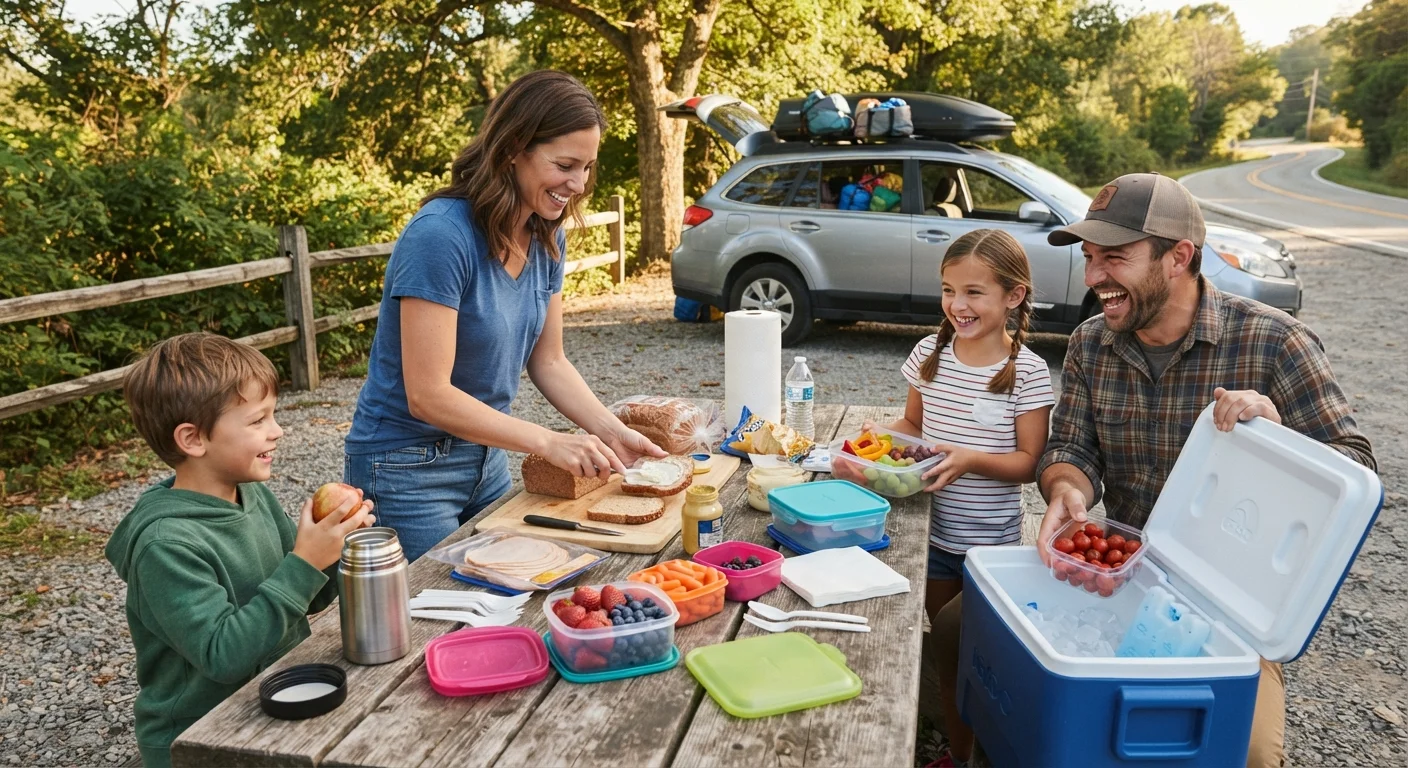
Cooler or insulated bag
Keeps perishable foods safe during road travel and day trips, enabling you to carry meals and snacks without stopping at restaurants.
Reusable water bottles (one per family member)
Eliminates the ongoing cost of purchased beverages, which can add $10-$20 per day for a family.
Reusable food containers and zip bags
Stores grocery-bought meals, leftovers, and snacks portably without needing to buy single-use packaging on the road.
Small cutting board and knife (for road trips)
Allows simple food prep - slicing fruit, cheese, or vegetables - without needing a full kitchen.
Grocery store locator app or map
Helps you find a full-service grocery store near your accommodation or along your route within the first 24 hours of arrival.
Don't Rely on Airport or Theme Park Food
Food sold at airports, theme parks, and major tourist attractions is typically priced at a significant premium over standard restaurant prices. Eating a meal before entering these venues, packing permitted snacks, or exiting to find nearby alternatives are all worth the effort. See common hidden costs that surprise families for a broader look at where vacation budgets leak.
Step-by-Step: Eating Well Without Constant Restaurant Spending
The steps below move in the order you'll encounter them: from pre-trip planning decisions through daily on-the-road habits. Each one addresses a specific moment where families typically overspend on food.
Food Costs Add Up Faster Than Most Families Expect
A family of four eating three restaurant meals daily can easily spend $150-$200 per day on food alone, depending on location and restaurant type. Over a seven-day trip, that's $1,000-$1,400 - often more than the cost of flights or lodging. Cutting even one meal per day through self-catering or smart alternatives can generate hundreds of dollars in real savings that can be redirected to experiences.
Book accommodation with food preparation in mind
Before finalizing any lodging, check whether it includes a kitchen, kitchenette, or at minimum a mini-fridge and microwave. Vacation rentals, extended-stay properties, and suite-style hotels often have these features at comparable or lower nightly rates than standard hotel rooms. The ability to prepare even basic meals - breakfast, lunch, and snacks - changes the economics of every day on the trip.
If a full kitchen isn't available, a mini-fridge alone allows you to store milk, yogurt, fruit, cold cuts, and leftovers, which is enough to self-cater two of three daily meals. Factor this into your accommodation search the same way you factor in location or amenities. This is covered in more depth in the step-by-step family trip planning guide.
Pack a snack and drink supply before you leave home
Assemble a travel snack kit at home using grocery prices rather than convenience store or rest stop prices. Include shelf-stable options: nuts, granola bars, dried fruit, crackers, peanut butter packets, and individual-serving cereals. Fill reusable water bottles before departure and pack an extra gallon of water for the cooler.
This single step eliminates the most common form of food budget drift - reactive spending on small purchases throughout the day that add up without feeling significant. A family of four spending $5-$8 per person on snacks and drinks at rest stops twice a day accumulates $60-$100 over a three-day road trip.
Do a grocery run within the first few hours of arrival
Identify a full-service grocery store near your destination before you travel, and make it your first stop - or a stop on the way in. Purchase enough to cover every breakfast and lunch for the trip, plus snacks and beverages. For a family of four on a seven-day trip, this typically costs $120-$180, compared to $600-$900 for equivalent restaurant meals.
Prioritize foods that require minimal prep: yogurt, fresh and dried fruit, sandwich ingredients, eggs (if you have a stovetop), instant oatmeal, cheese, and pre-washed salad greens. Buy a local specialty item or two - it's a low-cost way to experience regional food without a restaurant markup.
Establish a one-restaurant-meal-per-day pattern
Eating out is part of the travel experience - the goal isn't to eliminate it but to make it intentional. Plan for one restaurant meal per day (typically dinner), chosen in advance so you're selecting based on value and local character rather than hunger-driven convenience.
For the meal you do eat out, look for locally owned restaurants away from the main tourist corridor, which typically offer better value and more authentic food than tourist-district chains. Lunch specials at sit-down restaurants often offer near-identical food to dinner menus at significantly lower prices - shifting your restaurant meal to lunch and cooking or assembling dinner at the accommodation is another effective swap.
Use leftovers and batch prep strategically
If your accommodation has a kitchen, cook one or two slightly larger dinners that generate planned leftovers for the next day's lunch. Pasta, rice dishes, and roasted proteins hold well and reheat easily. This approach is similar to the at-home strategy described in stretching a grocery run into multiple dinners, and it applies just as effectively on the road.
Even without full cooking, buying a rotisserie chicken at the grocery store on day one can yield dinner, next-day sandwiches, and additions to a simple salad - three distinct uses from a single purchase that costs a fraction of three separate restaurant orders.
For families looking to apply these habits across the full scope of trip planning, the complete guide to budget family travel trade-offs covers how food decisions fit within the bigger spending picture.