

Key Takeaways
- Age-matched activities prevent boredom more reliably than a single one-size-fits-all approach.
- Breaking long travel days into predictable mini-segments helps kids manage waiting time.
- Physical movement during layovers reduces restlessness on subsequent legs of the journey.
- Novelty items reserved specifically for travel hold attention longer than familiar toys from home.
- Snack timing and food choices affect children's mood and focus during extended transit.
Why Long Travel Days Are Hard - and Plannable
Children aren't built to sit still for four, six, or ten hours. Their brains crave novelty, their bodies need movement, and their emotional regulation is still a work in progress. That's not a parenting failure - it's developmental biology. The families who navigate long travel days most smoothly tend to share one thing: they planned for the reality of their kids, not an idealized version.
Screens can help, and there's no need to feel guilty about using them strategically. But relying on a tablet as the sole plan leaves you exposed when the battery dies, the Wi-Fi drops, or a four-year-old simply hits a wall with passive viewing. A layered approach - pairing screen time with physical, creative, and social activities - gives you backup options and keeps kids more genuinely engaged.
Before diving into specific strategies, it helps to frame the day in segments rather than one long ordeal. See our guide to building a realistic family road trip itinerary for how this segmenting principle applies to route planning too.
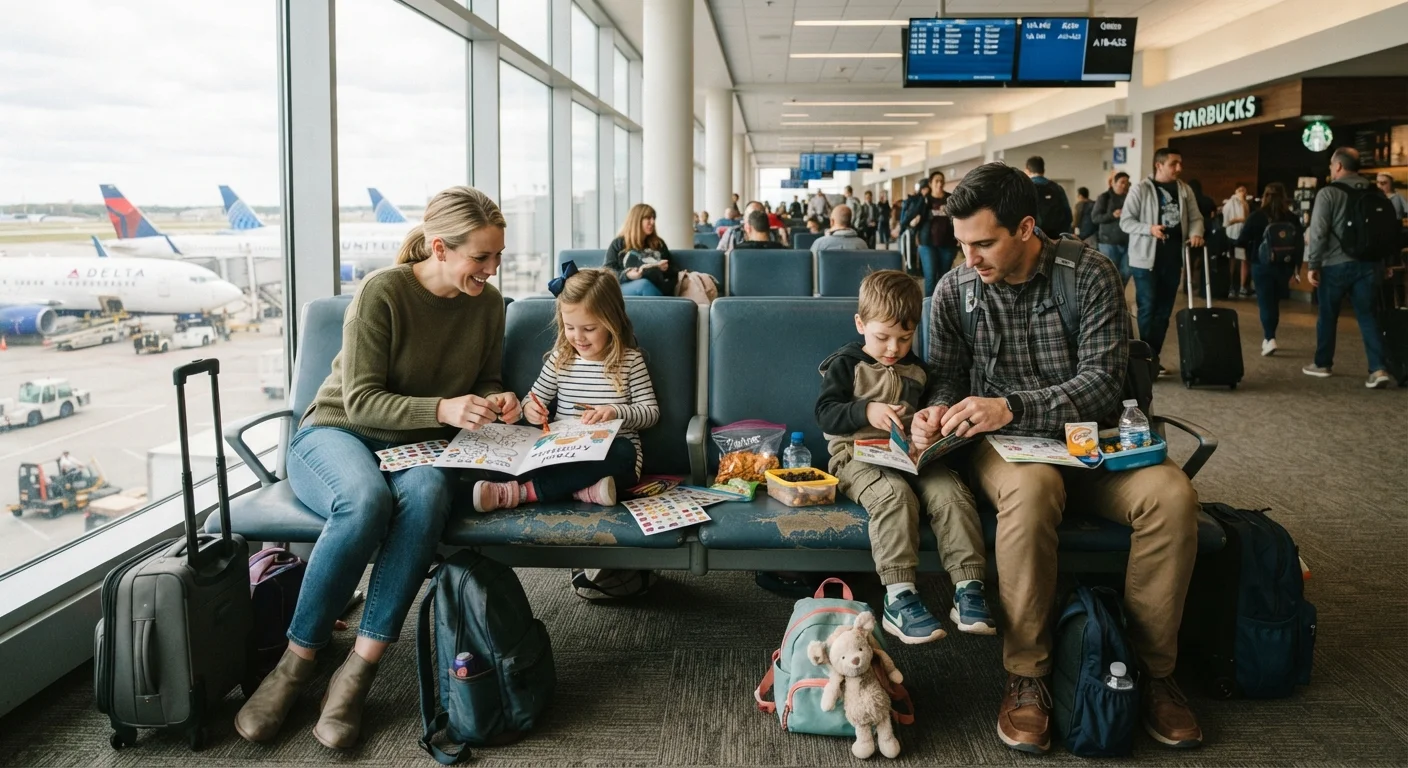
Pack a 'travel only' activity bag kids don't see until departure
Novelty is a powerful attention-holder for children. Items that appear only on travel days carry a freshness that familiar toys can't match. Think small activity books specific to their current interests, a new set of sticker sheets, a simple card game, or a travel-sized art set. Wrap each item loosely so unwrapping itself becomes a small event.
The key is strict rationing - reveal one item per segment, not all at once. A six-hour flight can yield four or five reveals if you pace them around natural transition points like takeoff, mealtime, and descent.
Novelty items revealed one at a time outlast a bag dumped out all at once.
Use layovers and rest stops for intentional movement
Physical activity before a long sitting stretch meaningfully reduces restlessness for most children. At airports, seek out a quiet gate area where kids can walk, do jumping jacks, or simply run short laps before boarding. Many larger airports have dedicated children's play areas - worth a quick search before your trip.
On road trips, factor movement stops into your plan proactively rather than reactively. A ten-minute stop at a rest area every two hours costs less time than managing a child who has reached their limit. See common mistakes families make planning trips with young children for why skipping these breaks tends to backfire.
Ten minutes of movement before boarding pays dividends for the next two hours of sitting.
Match activities to age and attention span honestly
A toddler and a ten-year-old have fundamentally different capacity for sustained activity. Toddlers typically engage with a single item for five to fifteen minutes before needing a switch; school-age children can often sustain focus for thirty minutes or more on something genuinely interesting to them. Packing age-inappropriate activities - too easy, too complex, or simply not interesting - wastes your limited entertainment budget.
For younger children: simple texture toys, board books, sticker scenes, and small figurines work well. For school-age kids: puzzle books, chapter books, travel journals, or strategy card games tend to hold attention longer. Tweens often engage well with creative writing prompts, sketchbooks, or offline game downloads on a device.
Age-matched activities prevent boredom more reliably than volume of options.
Build predictability into the day with a simple travel schedule
Children cope better with long waits when they have a mental map of what comes next. A simple, visual schedule - even hand-drawn - can reduce the repeated 'are we there yet?' cycle. Mark segments clearly: drive to airport, wait at gate, fly, layover, fly again, arrive. For younger kids, use pictures or drawings rather than clock times.
Narrate transitions as they happen. 'We're about to land - that's the halfway point' gives children a sense of progress and control that passive waiting doesn't. This approach is especially useful for children who struggle with uncertainty or transitions.
A simple visual schedule turns abstract waiting into a manageable sequence of steps.
Plan snacks strategically, not just abundantly
What kids eat during long travel days affects their focus and mood, not just their hunger. High-sugar snacks can produce a short energy spike followed by irritability - not ideal when you're stuck on a plane. Protein- and fiber-rich options (cheese, whole grain crackers, nuts for older kids, cut vegetables) tend to sustain energy and mood more evenly.
Snack timing also matters. Offering a snack at the start of a restless patch rather than as a last resort gives you something in reserve. Space snacks between activity reveals so each one signals a new mini-segment. For more on what makes snacks genuinely useful for kids, see our breakdown of snacks that sustain energy vs. fill time.
Snack timing shapes children's mood as much as snack quantity does.
Use screens intentionally, not as a default fallback
Screens aren't the enemy of a good travel day - unplanned screen use is. Designating specific screen windows (one episode after takeoff, one during the final hour) preserves their effectiveness and prevents the passive, glazed-over state that sets in after hours of continuous viewing. Download content in advance; streaming reliability on planes and in rural stretches of road is inconsistent.
Pair screen time with something active nearby: a fidget item in hand, headphones so siblings aren't affected, or a simple sketching task alongside the video. For a nuanced look at what the research actually says about screens and child development, see our breakdown of screen time research for kids.
Designated screen windows preserve their value better than open-ended device access.
Bringing It All Together
The best travel-day toolkit is one you've tested before departure. Run through your bag of activities during a long car ride locally, or let kids explore the contents the night before the trip so there are no surprises mid-flight. Adjust based on what actually held their attention - not what you hoped would.
Test Your Kit Before the Trip
Run through your activity bag during a shorter drive or waiting room visit before departure day. Kids who've already explored the contents once will engage with them more purposefully when it matters. Swap out anything that flopped and replace it with something that held genuine interest.
For age-specific pacing considerations on road trips specifically, road trip planning with kids by age group walks through how needs shift from toddlers to tweens. And if you're heading overseas, traveling internationally with kids for the first time covers what to expect from longer, more complex journeys. Long travel days are genuinely hard - but they're also finite. A little planning goes a long way toward arriving with everyone still speaking to each other.