

Key Takeaways
- Zero-based budgeting assigns every dollar of income a specific job, leaving a balance of zero at month's end.
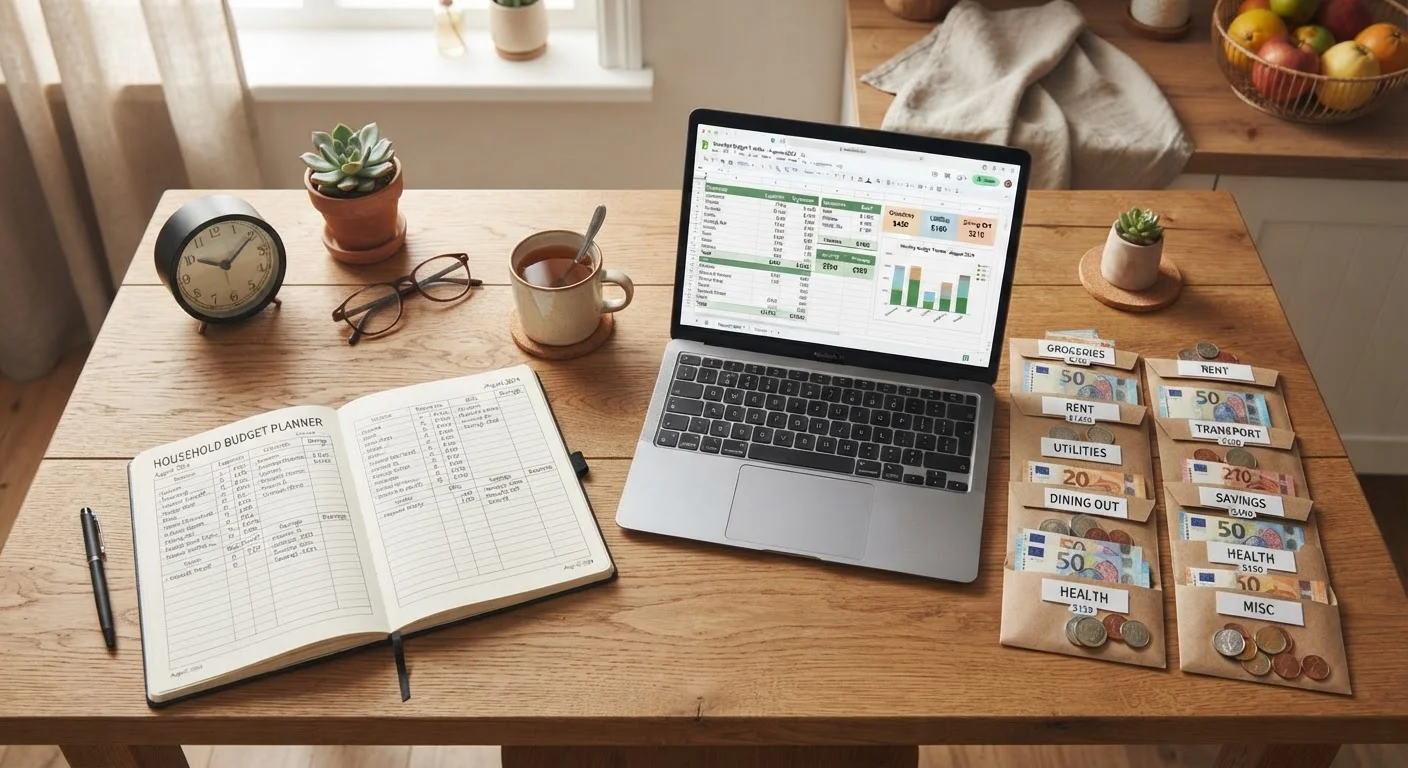
- The envelope method divides cash into labeled envelopes for each spending category — when the cash is gone, spending stops.
- Zero-based budgeting works well for households with predictable income who want detailed financial control.
- The envelope method is especially effective for reining in habitual overspending in categories like groceries or dining out.
- Both methods require regular tracking, but zero-based budgeting typically demands more upfront planning time.
- Neither approach guarantees results — consistency and adjustment over time matter more than which method you choose.
Option A
Zero-Based Budgeting
The thorough, category-by-category allocation framework.
Best for: Households that want complete visibility over every dollar and are comfortable working with digital tools or detailed spreadsheets.
Option B
Envelope Method
The tactile, cash-driven spending control system.
Best for: Households that tend to overspend on variable categories and benefit from a physical, hands-on limit they can see and feel.
If you want total oversight of every spending category
Zero-Based Budgeting
Zero-based budgeting forces you to account for every dollar before the month begins, making it easier to spot waste and redirect funds toward goals.
If overspending on everyday purchases is your biggest challenge
Envelope Method
Physical cash limits make it nearly impossible to exceed a category budget without a conscious decision, which builds real spending discipline.
If your household income varies month to month
Zero-Based Budgeting
Zero-based budgeting can be rebuilt each month around actual income received, making it more flexible for irregular earners than a fixed cash-envelope setup.
If you prefer simplicity over detailed tracking
Envelope Method
The envelope system requires minimal record-keeping — your remaining cash tells you exactly where you stand without spreadsheets or apps.
If you primarily pay bills and shop digitally
Zero-Based Budgeting
Zero-based budgeting integrates easily with apps and spreadsheets, while the cash-based envelope method creates friction for households that rarely use physical currency.
How Each Method Actually Works
Understanding the mechanics of each approach is the first step toward choosing one. If you're new to household budgets entirely, the family budgeting starter guide covers the foundational concepts worth knowing before diving in.
Zero-Based Budgeting
With zero-based budgeting (ZBB), you start each month with your total expected income and assign every single dollar to a category — rent, groceries, utilities, savings, debt payments, entertainment, and so on — until you reach zero. The goal isn't to spend everything; it's to give each dollar a deliberate purpose. Savings and investments count as categories too. If your income is $4,800 and your assigned categories add up to $4,800, your budget is balanced.
The Envelope Method
The envelope method is a cash-based system. At the start of each pay period, you withdraw physical cash and divide it into labeled envelopes — one for groceries, one for gas, one for dining out, and so on. When an envelope is empty, spending in that category stops for the period. There's no rolling over and no borrowing between envelopes unless you make a deliberate, conscious trade-off. The system works because the constraint is tangible rather than theoretical.
| Criterion | Zero-Based Budgeting | Envelope Method |
|---|---|---|
| Core mechanism | Assign every dollar a category digitally | Divide physical cash into labeled envelopes |
| Setup time | 30–60 min per month | 15–30 min per pay period |
| Ongoing tracking effort | Moderate — requires regular check-ins | Low — remaining cash shows balance |
| Works with digital payments | Yes, fully compatible | Limited — cash-focused by design |
| Best income type | Regular or irregular income | Regular, predictable income |
| Behavioral spending check | Relies on self-discipline and tracking | Built-in — empty envelope stops spending |
| Tools needed | App, spreadsheet, or pen and paper | Cash and physical envelopes |
| Learning curve | Moderate | Low |
The Real-World Trade-Offs
Both systems demand commitment, but they ask for different things. Zero-based budgeting requires more planning time upfront — typically 30 to 60 minutes at the start of each month — and ongoing tracking throughout the period to make sure allocations hold. Digital tools and budgeting apps versus spreadsheets can ease that burden considerably.
The envelope method is simpler to maintain but carries its own friction. Withdrawing and sorting cash takes time, carrying envelopes is impractical for many people, and it doesn't translate well to online bill payments or subscription services. Some households adapt by using a hybrid: digital tracking for fixed expenses like rent and utilities, and physical envelopes only for variable spending categories like groceries and entertainment.
A Note on Hybrid Approaches
Many households find that neither method alone fits perfectly — and that's fine. A common practical solution is to use zero-based budgeting for the overall monthly plan and reserve the envelope method only for the two or three categories where overspending is most frequent. Mixing methods isn't cheating; it's adapting the tools to fit real life. What matters is that the system you use is one you'll actually stick with.
One honest limitation of both methods: they work best with a relatively stable monthly income. If you're a freelancer or gig worker with unpredictable earnings, additional strategies — like building a one-month income buffer — are worth exploring through a broader saving strategies framework.
Choosing the Right Fit for Your Household
There's no universally superior method. The right choice depends on your household's specific habits, income pattern, and tolerance for administrative work.
Zero-based budgeting tends to suit households that have a consistent monthly income, enjoy working with numbers or tracking tools, and want comprehensive financial visibility. It scales well when you have multiple financial goals running simultaneously — saving for a home down payment while paying down credit card debt, for example.
The envelope method tends to work better for households where the core problem is behavioral: spending feels abstract until the money is physically gone. Research on consumer behavior suggests people spend more freely with cards than with cash, which is part of why the tactile constraint the envelope system provides can be so effective for curbing habitual overspending. For a closer look at what cash-only spending feels like in practice, see cash-only spending periods and their trade-offs.
Whichever method you choose, the complete household finance framework can help you build the surrounding structure — tracking, adjusting, and staying consistent as your family's needs evolve over time.
This article is for general informational purposes only and does not constitute personalized financial advice. Consult a qualified financial professional for guidance tailored to your specific situation.