

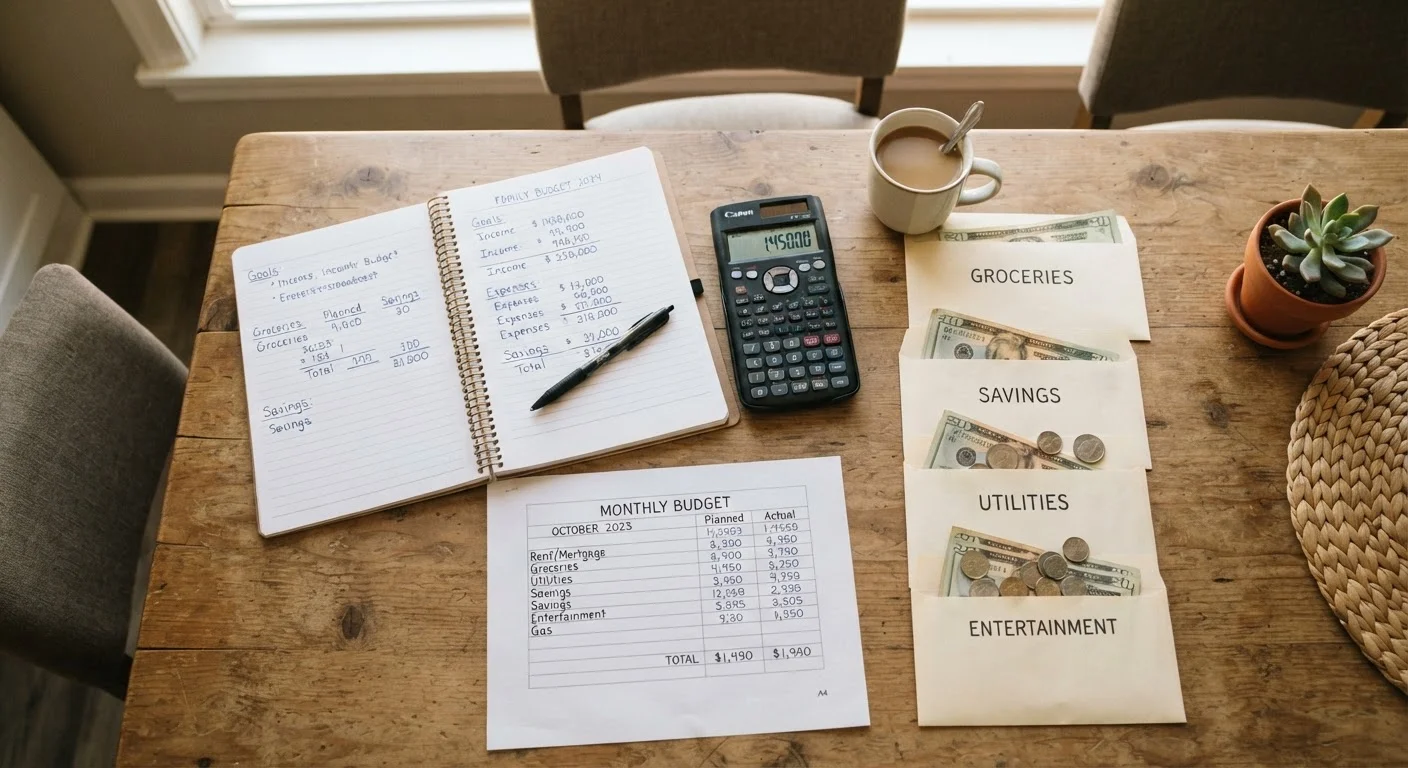
Key Takeaways
- Zero-based budgeting assigns every dollar of income a specific job before the month begins, leaving a balance of zero.
- Envelope budgeting divides cash into labeled categories so spending stops automatically when the envelope is empty.
- Zero-based budgeting suits detail-oriented planners; envelope budgeting suits those who respond better to physical limits.
- Both methods require consistent monthly setup — neither runs on autopilot.
- Families can hybrid both approaches, using zero-based planning with digital or physical envelopes for variable spending.
Option A
Zero-Based Budgeting
The meticulous, every-dollar-has-a-job approach.
Best for: Families who want complete visibility over every spending category and are comfortable working in spreadsheets or budgeting apps.
Option B
Envelope Budgeting
The hands-on, spend-only-what's-in-front-of-you method.
Best for: Families who tend to overspend in specific categories and benefit from a physical or visual spending limit they can see and touch.
If you want full control over every spending category each month
Zero-Based Budgeting
Zero-based budgeting forces you to consciously assign every dollar, making it easier to spot waste and redirect money toward savings goals.
If you struggle with overspending on groceries, dining, or entertainment
Envelope Budgeting
The hard stop built into each envelope prevents category overspending without requiring willpower alone — once it's gone, it's gone.
If your income varies month to month
Zero-Based Budgeting
Zero-based budgeting is rebuilt fresh each month, making it easier to adjust allocations when income fluctuates rather than stretching fixed envelopes.
If you prefer a low-tech, no-app budgeting system
Envelope Budgeting
Physical cash envelopes require no software, subscription, or digital literacy — just labeled envelopes and discipline at the ATM.
If you want to combine structure with flexibility
Zero-Based Budgeting
A zero-based framework can incorporate digital envelope categories, giving you both the planning discipline and the spending guardrails families need.
How Each Method Works
Both zero-based budgeting and envelope budgeting are intentional spending systems — meaning you decide where money goes before you spend it, rather than reviewing damage after the fact. But they differ meaningfully in structure and execution.
Zero-based budgeting (ZBB) starts with your total monthly income and requires you to assign every single dollar to a category — housing, groceries, utilities, savings, debt payments, entertainment — until your income minus your allocations equals zero. That zero doesn't mean you're broke; it means every dollar has a designated purpose. You rebuild this plan each month from scratch, which is where the discipline lives.
Envelope budgeting works by dividing a portion of your monthly income into discrete spending pools — traditionally physical cash envelopes labeled by category. When the grocery envelope is empty, grocery spending stops until next month. There's no math trick; the limit enforces itself. Digital versions of this method use app-based virtual envelopes to replicate the same constraint without cash.
If you're new to household budgeting generally, our practical starting point guide walks through income-and-expense basics before you commit to either system.
| Criterion | Zero-Based Budgeting | Envelope Budgeting |
|---|---|---|
| Core mechanism | Assign every dollar a job; balance = zero | Spend only what's physically in each envelope |
| Setup time | 30–60 min per month | 15–30 min per month |
| Tools needed | Spreadsheet or budgeting app | Cash and labeled envelopes (or app) |
| Works with digital payments | Yes, fully compatible | Partially — cash-based by design |
| Handles variable income | Well — rebuilt fresh each month | Requires adjustment when income shifts |
| Spending discipline mechanism | Intentional planning; self-enforced | Physical limit enforces itself |
| Learning curve | Moderate — requires comfort with numbers | Low — intuitive once set up |
| Best suited for | Detail-oriented, planning-focused households | Households prone to impulse overspending |
What Each Method Actually Requires
Choosing between these two systems isn't just about preference — it's about being honest with yourself about the kind of discipline each demands.
Zero-based budgeting requires time upfront each month. You'll typically spend 30–60 minutes reviewing last month's actuals, adjusting category amounts, and balancing your new plan to zero. It rewards people who are comfortable with numbers, enjoy spreadsheets or apps, and can commit to checking category balances mid-month. The method works especially well for households with irregular bills or fluctuating income, because every month gets a fresh, custom plan.
Envelope budgeting requires behavioral change at the point of spending. The setup is simpler — withdraw cash, sort it, and spend only what's in each envelope — but the friction is real. Paying for a full grocery run in cash feels different than swiping a card. That friction is the feature, not a bug. For families who know intellectually that they overspend on dining out but keep doing it anyway, the physical limit interrupts the habit loop.
~33%
US adults who follow a formal budget
Gallup polling has consistently found that fewer than one in three American adults track spending through a structured budget, underscoring how much room most families have to gain from either method.
$500+
Average monthly household discretionary overspend
Consumer financial studies suggest many US households spend several hundred dollars monthly beyond their intended discretionary budget, primarily in food, dining, and entertainment categories.
It's also worth comparing both methods against percentage-based approaches. Our overview of the 50/30/20 rule outlines how a looser framework might suit households that find either of these methods too rigid.
Strengths, Weaknesses, and the Hybrid Middle Ground
Neither method is universally superior. Each has real trade-offs worth weighing.
Zero-based budgeting strengths: granular control, adaptability each month, works with direct deposit and digital payments, easy to track savings progress. Weaknesses: time-intensive, can feel overwhelming for budgeting beginners, easy to fudge numbers in a spreadsheet without real consequences.
Envelope budgeting strengths: spending hard stops are automatic, no apps required, viscerally effective for impulse-spending patterns. Weaknesses: cash management is inconvenient for online purchases and subscriptions, easy to let physical envelopes get disorganized, doesn't cover fixed bills like rent or car payments naturally.
Many families find the most traction with a hybrid approach: use zero-based planning to allocate all fixed and savings categories, then apply envelope-style limits (physical or digital) only to variable spending categories like groceries, entertainment, and clothing. This captures the planning discipline of ZBB and the behavioral guardrails of envelope budgeting without the downsides of either in isolation.
For a broader household finance framework that can accommodate either method, see our complete household finance guide.
This article is for general informational and educational purposes only and does not constitute personalized financial advice. Consult a qualified financial professional for guidance specific to your household situation.