

Key Takeaways
- Dealer financing is convenient but may include rate markups that increase your total loan cost.
- Getting pre-approved at a bank or credit union before visiting a dealer strengthens your negotiating position.
- Credit unions often offer lower rates than banks or dealers, especially for members with solid credit histories.
- Promotional 0% APR dealer offers are real but typically require strong credit and a short loan term.
- Comparing at least two financing offers before signing can save hundreds or thousands over the loan's life.
- Auto loans are secured debt - the vehicle serves as collateral regardless of where you borrow.
Option A
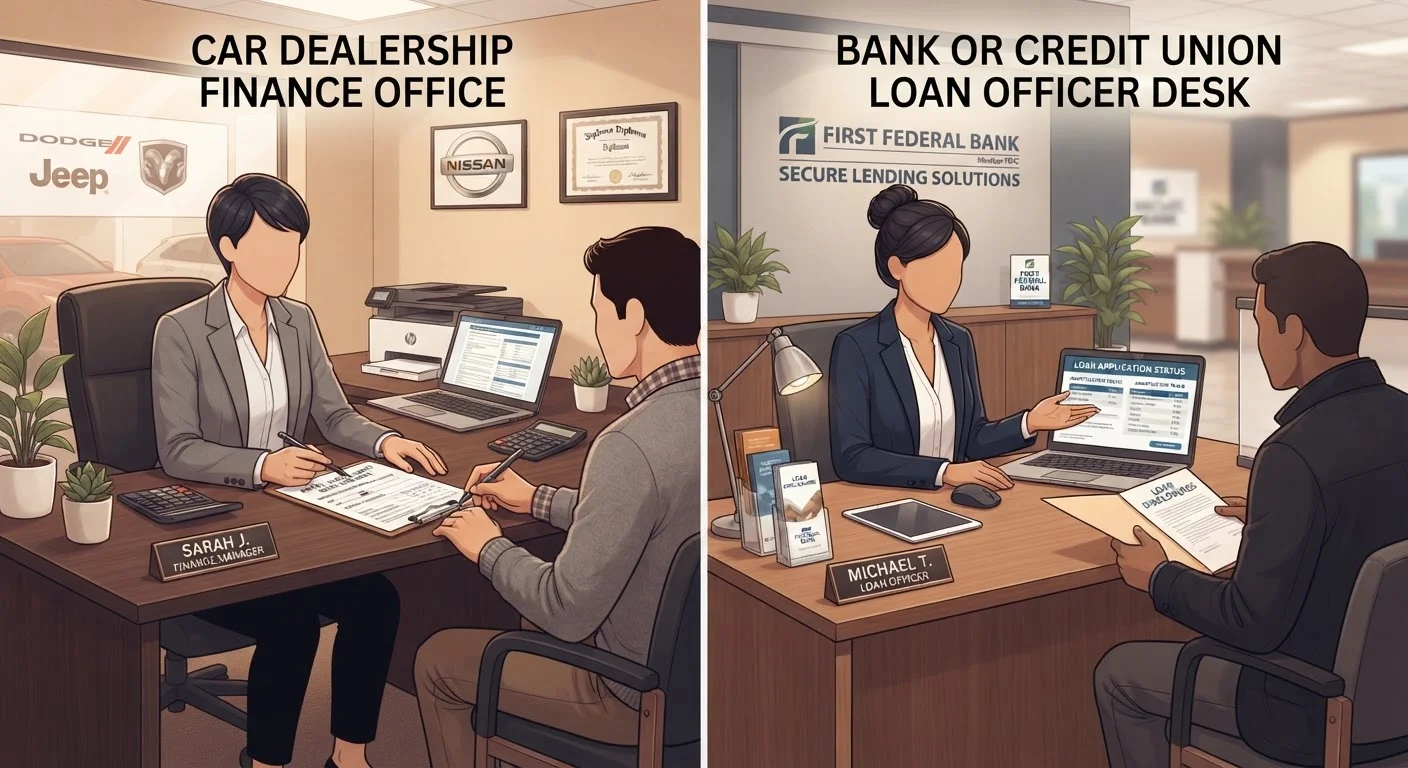
Dealer Financing
The convenient, one-stop financing option arranged at the point of sale.
Best for: Buyers who want to handle everything in one place, especially when manufacturers offer promotional rates.
Option B
Bank or Credit Union Financing
The independent, pre-arranged loan that puts negotiating power in your hands.
Best for: Buyers who want rate transparency and leverage before stepping onto the lot.
If you want the simplest, fastest transaction on the lot
Dealer Financing
Dealer financing consolidates the purchase and loan into one appointment, which saves time - though you should still verify the rate is competitive.
If minimizing total interest paid is your top priority
Bank or Credit Union Financing
Credit unions in particular tend to offer lower APRs, and arriving with a pre-approval gives you a concrete rate benchmark the dealer must beat to win your business.
If a manufacturer is advertising 0% or very low promotional APR
Dealer Financing
Manufacturer-sponsored promotional rates through the dealership can be genuinely hard to match elsewhere - verify you qualify and confirm no other incentives are forfeited.
If your credit score is below average or you have limited credit history
Bank or Credit Union Financing
Your own bank or a credit union where you already have a relationship may offer more flexible underwriting than a dealership's indirect lender lineup.
How Each Financing Path Actually Works
When you finance through a dealership, you're not usually borrowing directly from the dealer. The dealer acts as a middleman: it submits your application to a network of lenders, selects an offer, and presents it to you. The dealer may earn a fee - sometimes called a finance reserve - based on the difference between the lender's approved rate and the rate you actually sign. This markup is legal and common, but it's not always disclosed upfront.
When you borrow directly from a bank or credit union - known as direct lending - you apply before you shop, receive a pre-approval letter stating your rate and maximum loan amount, and bring that offer to the dealership. You negotiate the vehicle price separately from the financing, which keeps the two conversations distinct and easier to evaluate. For a broader look at how debt instruments like auto loans work structurally, see how secured debt shapes your options.
| Criterion | Dealer Financing | Bank / Credit Union Financing |
|---|---|---|
| Application timing | At the dealership, during purchase | Before you shop (pre-approval) |
| Rate transparency | Rate may include undisclosed markup | Rate quoted directly to borrower |
| Negotiating leverage | Lower - price and payment bundled | Higher - financing and price separated |
| Promotional APR access | Yes, via manufacturer programs | No access to manufacturer promos |
| Typical rate competitiveness | Varies; can be higher due to markup | Credit unions often lowest available |
| Convenience | High - one-stop transaction | Requires a separate application step |
| Who approves the loan | Third-party lender via dealer | Your bank or credit union directly |
The Real Cost Difference: Rates, Markups, and What to Watch For
The annual percentage rate (APR) is the single most important number to compare. A difference of even one percentage point on a $30,000, 60-month loan adds up to roughly $800 in extra interest paid over the life of the loan - real money for any family budget.
Dealer financing markup varies by lender agreement and credit tier, but the Consumer Financial Protection Bureau (CFPB) has historically flagged dealer markup practices as a source of pricing disparities. Credit unions, by contrast, are member-owned nonprofits, which structurally motivates them to return value through lower loan rates rather than maximize profit. That said, your individual rate will always depend on your credit score, loan term, and down payment - not just where you borrow. How loan term length shapes total interest paid is worth understanding before you decide on a repayment period.
~$800
Extra interest on 1% APR difference
Estimated additional cost on a $30,000, 60-month loan at 1 percentage point higher APR, based on standard loan amortization math.
1-2.5%
Typical dealer finance markup range
Industry and regulatory sources have indicated dealer reserve markups historically ranged from roughly 1 to 2.5 percentage points above the lender's buy rate.
2+
Minimum financing offers to compare
Financial educators broadly recommend obtaining at least two competing loan offers before committing, to establish a genuine rate benchmark.
One tactic that can work in your favor: get a pre-approval from your bank or credit union first, then let the dealer try to beat it. If the dealer can match or undercut the rate, you win either way. If they can't, you already have your financing lined up.
This article is for general informational purposes only and does not constitute personalized financial or legal advice. Consult a qualified financial professional for guidance specific to your situation.
Promotions, Fine Print, and When Dealer Financing Wins
There are genuine scenarios where dealer financing makes financial sense. Manufacturer-sponsored promotional APR offers - sometimes as low as 0% for qualified buyers - are funded by the automaker, not a markup, and direct lenders simply cannot match them. These promotions typically require a credit score in the good-to-excellent range (often 700+) and apply only to specific models or trim levels.
The catch is that accepting a promotional financing rate sometimes means forfeiting a cash rebate on the same vehicle. You'll need to do the math: does the 0% rate save more than the rebate would have reduced your purchase price? The answer depends on the rebate amount, loan size, and term. Dealers are not obligated to walk you through this comparison proactively - that's your job going in.
Also watch for add-on products presented in the finance office: extended warranties, gap insurance, credit life insurance, and paint protection packages. These are often profitable for the dealership and may be available elsewhere at lower cost. Understand what you're agreeing to before signing. For a fuller picture of costs families often miss when budgeting for a vehicle, see car ownership costs families frequently underestimate. If you're still deciding whether to buy at all versus lease, buying vs. leasing trade-offs for families covers that ground.