

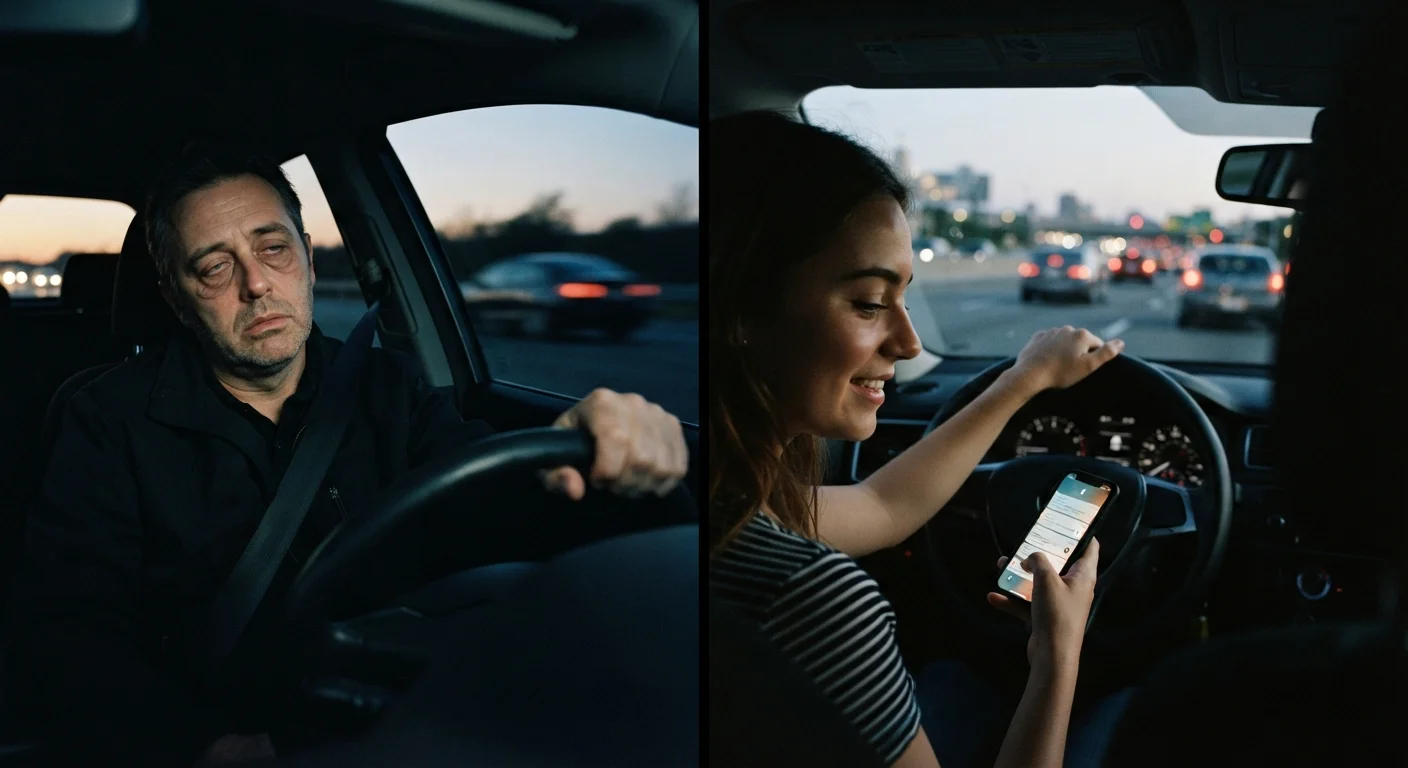
Key Takeaways
- Drowsy driving degrades judgment gradually, making drivers less aware of their own impairment over time.
- Distracted driving removes attention in discrete moments - even a 2-second glance can cover significant road distance.
- Both impairments increase crash risk substantially, though through different cognitive and physical mechanisms.
- Microsleep episodes from drowsiness can last several seconds with zero driver awareness or control.
- Recognizing which type of impairment is affecting you is the first step toward correcting the behavior.
Option A
Drowsy Driving
The silent, slow-building impairment that sneaks up on drivers.
Best for: Understanding the cumulative dangers of sleep deprivation behind the wheel and how to recognize warning signs before they become emergencies.
Option B
Distracted Driving
The moment-to-moment attention thief that removes eyes and mind from the road.
Best for: Understanding how brief mental or visual interruptions can eliminate reaction time entirely in a fraction of a second.
If you drive long distances or work irregular hours
Drowsy Driving awareness
Sleep-deprived or shift-working drivers are especially vulnerable to gradual performance decline. Prioritizing rest and planning stops is essential.
If you regularly use a smartphone or navigation device while driving
Distracted Driving awareness
Even hands-free phone use creates cognitive distraction. Managing device use before moving is the most effective prevention.
If you're a parent teaching a teen to drive
Distracted Driving awareness
Teen drivers are statistically more likely to be impaired by distraction. Setting clear no-phone rules early builds lasting safe habits.
How Each Type of Impairment Works
Drowsy driving and distracted driving both erode a driver's ability to respond safely - but they operate through very different mechanisms, and conflating the two can lead to underestimating either risk.
Drowsy driving is a physiological state. Sleep deprivation slows neural processing speed, impairs decision-making, and reduces the brain's ability to monitor its own performance. A driver who hasn't slept enough may not feel dangerously impaired because the very faculties needed to judge impairment are themselves degraded. The most serious manifestation is microsleep - involuntary sleep episodes lasting two to thirty seconds during which the driver has no awareness or control whatsoever. At highway speeds, that represents hundreds of feet traveled completely blind.
Distracted driving works differently. Rather than a gradual decline, distraction removes attention in discrete, measurable bursts. There are three categories: visual (eyes off the road), manual (hands off the wheel), and cognitive (mind off the task of driving). Texting while driving is particularly dangerous because it combines all three simultaneously. According to the National Highway Traffic Safety Administration (NHTSA), reading or sending a text takes roughly five seconds - enough time to travel the length of a football field at 55 mph without looking up.
For a broader picture of how these risks fit into everyday driving, see our guide on defensive driving principles.
Side-by-Side: Comparing the Two Impairments
The table below illustrates how drowsy and distracted driving differ across key safety dimensions.
| Criterion | Drowsy Driving | Distracted Driving |
|---|---|---|
| Primary mechanism | Physiological - impaired neural function | Attentional - divided or absent focus |
| Onset pattern | Gradual, cumulative over time | Sudden, episode-based |
| Driver self-awareness | Often low - impairment masks itself | Often higher - driver may know they looked away |
| Worst-case event | Microsleep: zero control for 2-30 seconds | Full inattention during a multi-second glance |
| Duration of risk | Sustained across entire trip | Intermittent but potentially frequent |
| Main risk factor | Insufficient sleep, shift work, long hours | Smartphones, passengers, in-car systems |
| Primary countermeasure | Adequate rest; planned stops | Device management before driving |
One important distinction: drowsy drivers often retain some degree of control and may correct briefly before impairment worsens, whereas a distracted driver in a microsecond inattention event has no input into the vehicle at all. Conversely, drowsy driving can persist for an entire trip, compounding risk over time, while distraction episodes are often shorter but may recur constantly.
91,000+
Drowsy driving crashes annually (NHTSA estimate)
The NHTSA estimates drowsy driving was responsible for over 91,000 police-reported crashes in a recent study year, though the true figure is considered underreported.
~5 sec
Average eyes-off-road time when texting
NHTSA research indicates the average text takes about five seconds to read or send - enough to travel the length of a football field at highway speed.
3,000+
Annual distraction-related traffic fatalities
NHTSA data consistently shows distracted driving accounts for thousands of traffic deaths each year across the United States.
Warning Signs and Self-Assessment
Recognizing impairment in yourself is harder than it sounds - and that difficulty is most acute with drowsiness.
Signs You May Be Too Drowsy to Drive
- Difficulty keeping your eyes focused or open
- Missing exits or not remembering the last several miles
- Drifting from your lane or hitting rumble strips
- Yawning repeatedly or head-nodding
Signs You're Driving While Distracted
- Reaching for a device while moving
- Glancing at a map, food, or passenger for more than a second
- Losing track of surrounding vehicles or road conditions
- Arriving at a destination with little memory of the route
Older drivers may face compounding challenges. Aging affects reaction time and attention in ways that can make both drowsy and distracted driving even more consequential.
Cognitive Distraction Is Invisible to Others
A driver using a hands-free phone may appear to be driving normally - eyes forward, hands on the wheel - but research from the AAA Foundation for Traffic Safety shows that cognitive distraction significantly reduces awareness of the driving environment. This is sometimes called 'inattention blindness.' It means that legal hands-free device use is not necessarily safe use. Plan calls and podcasts around your drive, not during it.
Practical Strategies for Each Risk
The right countermeasure depends on which impairment you're addressing.
Reducing Drowsy Driving Risk
- Prioritize seven to nine hours of sleep before any long drive - not just the night before, but consistently.
- Schedule breaks every two hours or 100 miles on extended trips.
- Travel with a partner who can share driving duties.
- If you feel drowsy, pull over safely and rest; caffeine can offer short-term alertness but is not a substitute for sleep.
Reducing Distracted Driving Risk
- Place your phone in do-not-disturb mode before starting the engine.
- Set GPS routes before moving - not while driving.
- If a call or message is urgent, pull over safely to handle it.
- Model safe habits for teen passengers and new drivers in your household.
Both risks are also heightened in challenging road conditions. Our article on driving in rain, fog, and snow covers how environmental factors compound the dangers of any cognitive impairment.
This article is for general informational and educational purposes only and does not constitute professional safety, medical, or legal advice. Always follow applicable traffic laws and consult relevant authorities for guidance specific to your situation.