

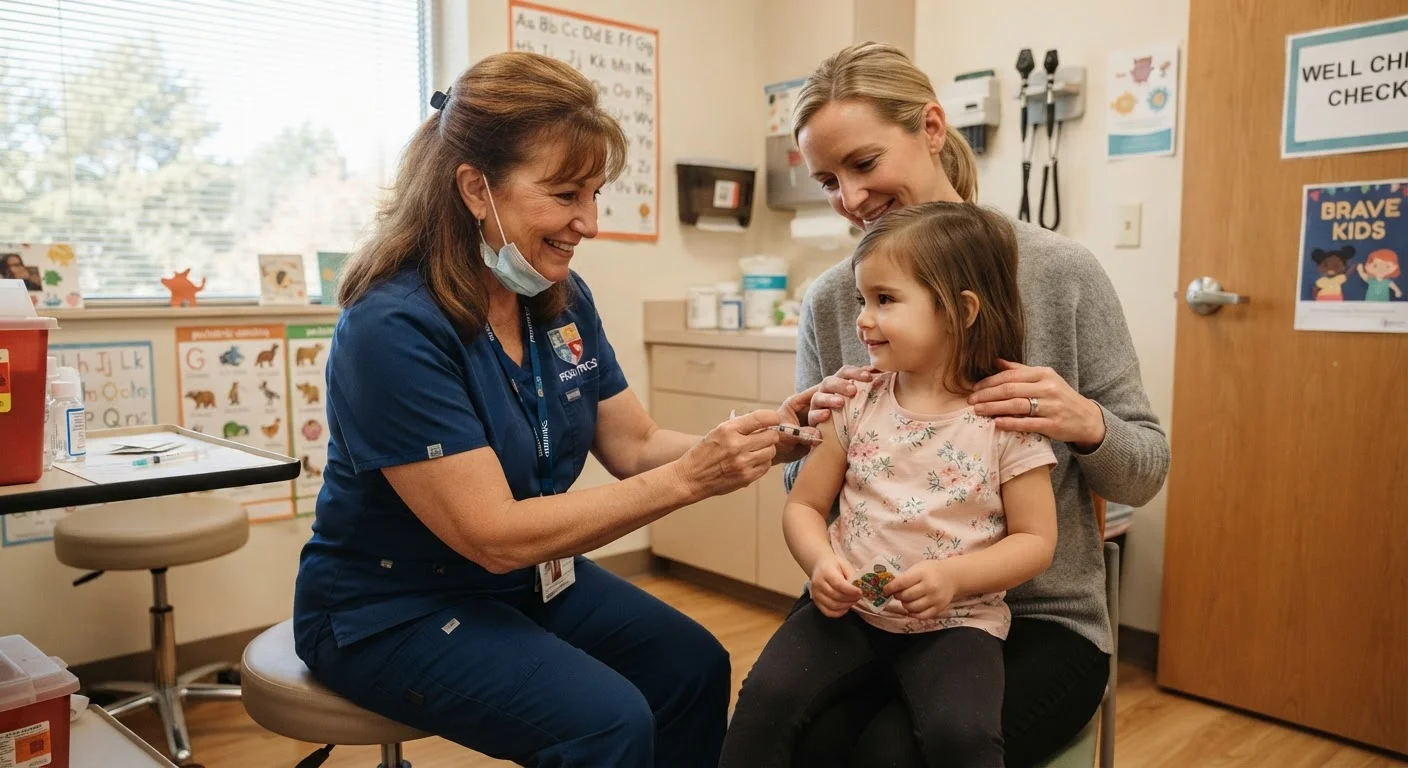
Key Takeaways
- The CDC and AAP recommend a specific vaccine schedule timed to when children are most at risk for serious illness.
- Most childhood vaccines require multiple doses to build full, lasting immunity.
- Skipping or delaying vaccines leaves children unprotected during vulnerable early years.
- Side effects from vaccines are usually mild and temporary; serious reactions are rare.
- Well-child visits are the primary setting where immunizations are reviewed and administered.
- Parents with questions or concerns should always consult their child's pediatrician.
Childhood Immunization Schedule
A childhood immunization schedule is a timetable - developed by medical experts - that outlines which vaccines are recommended for children from birth through adolescence, and at what ages they should be given. These schedules are designed to protect children at the ages when they are most vulnerable to specific diseases. Following the schedule helps ensure that immunity builds up reliably and at the right time.
In the United States, the Advisory Committee on Immunization Practices (ACIP) develops vaccine schedules, which are then endorsed by the American Academy of Pediatrics (AAP) and the American Academy of Family Physicians (AAFP). These schedules are reviewed and updated annually.
Why Timing Is Everything
Vaccines aren't placed on a schedule arbitrarily. Each immunization is timed to the window when a child's immune system can respond most effectively - and before the risk of serious disease is highest. For example, infants lose the maternal antibodies they're born with within a few months of birth, leaving them especially vulnerable. Starting vaccines early in life closes that gap.
Timing also matters because some diseases are far more dangerous in young children than in older ones. Pertussis (whooping cough), for instance, can be life-threatening in infants but manageable in adults. Vaccinating on schedule - rather than waiting - protects children precisely when they need it most.
If you want a broader view of how routine preventive care fits into your child's health plan, our Annual Well-Child Visit Checklist for Parents is a helpful companion resource for each checkup.
Keep a Personal Immunization Record
Ask your child's doctor's office for an up-to-date copy of your child's vaccination record at each visit and store it somewhere accessible - a folder with other key health documents works well. Schools, camps, and childcare programs often require proof of immunization, so having the record handy saves time. Many states also offer online immunization registries where you can access this information digitally.
A Stage-by-Stage Overview of the Schedule
The US immunization schedule spans from birth through the teenage years. Here's a general overview of the major phases - keep in mind that your child's doctor will provide the exact timetable based on your child's health history.
Birth to 15 Months
This is the most vaccine-intensive period. Immunizations typically given during this window include protection against hepatitis B, rotavirus, diphtheria, tetanus and pertussis (DTaP), Hib (Haemophilus influenzae type b), pneumococcal disease, polio, influenza, measles, mumps and rubella (MMR), varicella (chickenpox), and hepatitis A. Many of these require a series of two to four doses spaced weeks or months apart.
Ages 4 to 6 Years
Just before children start school, a booster round is recommended for several vaccines, including DTaP, polio, MMR, and varicella. These boosters reinforce immunity that may have weakened since the initial series.
Preteens and Teens (Ages 11-18)
This phase introduces new protections. The Tdap booster (tetanus, diphtheria, and pertussis), meningococcal vaccine, and HPV vaccine are all recommended during adolescence. An annual flu vaccine is recommended for all ages throughout childhood.
14
Diseases prevented by vaccines before age 2
According to the CDC, the US childhood immunization schedule protects against 14 potentially serious diseases before a child's second birthday.
~90-95%
MMR vaccine effectiveness after two doses
The CDC reports that two doses of the MMR vaccine are approximately 97% effective against measles and about 88% effective against mumps, offering strong community-level protection.
1 in a million
Estimated rate of serious allergic vaccine reactions
The CDC notes that severe allergic reactions (anaphylaxis) following vaccination occur at an estimated rate of roughly one to two per million doses administered.
Understanding Common Side Effects
It's completely normal to feel uneasy when your child cries after a shot. Most side effects are mild and short-lived - soreness or redness at the injection site, a low-grade fever, or fussiness for a day or two. These reactions are actually signs that the immune system is responding and building protection.
Serious allergic reactions to vaccines are rare. Providers keep children in the office for a brief observation period after vaccination for this reason. If your child develops a high fever, unusual behavior, or any symptom that worries you in the days following a vaccine, contact your pediatrician. Our article on fever in children can help you gauge what warrants a call to the doctor.
Addressing Common Parent Concerns
Questions about vaccine safety are natural, and it's always appropriate to bring them to your child's doctor. Decades of large-scale safety studies and real-world data support the current immunization schedule. Major health organizations - including the CDC, AAP, and World Health Organization - consistently affirm that the benefits of vaccination far outweigh the risks for the vast majority of children.
Some parents wonder whether spreading vaccines out over time might be safer. Current evidence does not support this approach; it simply leaves children unprotected for longer. If you have specific concerns - whether due to a family health history or a prior reaction - your pediatrician can work with you individually rather than applying a blanket delay.
“Vaccines are one of the greatest public health achievements of the 20th century. They protect not just individuals, but entire communities by reducing the spread of disease.”
— Centers for Disease Control and Prevention, US Federal Public Health Agency
For a fuller picture of how immunizations fit into your family's overall preventive health habits, see our guide on preventive screenings every family should know about by age.
This article is for general informational purposes only and is not a substitute for professional medical advice. Always consult your child's pediatrician for guidance tailored to your child's individual health needs.