

Key Takeaways
- Power tools aren't always the better choice - hand tools offer superior control for detail and finish work.
- Hand tools generally cost less upfront and require minimal maintenance or storage space.
- Power tools dramatically reduce fatigue and time on large, repetitive tasks like framing or decking.
- Safety risks differ between the two: power tools demand stricter precautions and protective gear.
- The smartest approach is a mixed toolkit - each type excels in specific situations.
- Matching the tool to the task protects your materials, your budget, and your safety.
Option A
Hand Tools
The precise, quiet, and budget-friendly classic.
Best for: Detail work, delicate materials, tight spaces, and beginners building foundational skills.
Option B
Power Tools
The fast, high-output workhorse for bigger jobs.
Best for: High-volume tasks, repetitive cuts, and projects where speed and consistent force are essential.
If you're a first-time DIYer building basic skills
Hand Tools
Hand tools are forgiving, affordable, and help you develop control and technique before moving to motorized equipment.
If you're tackling a large framing, decking, or renovation project
Power Tools
Power tools reduce physical strain and cut project time significantly when the same motion is repeated dozens or hundreds of times.
If precision and finish quality are the top priority
Hand Tools
For joinery, trim work, and fine woodworking, hand tools give you the tactile feedback needed to avoid costly mistakes.
If you work in tight or awkward spaces without power access
Hand Tools
Hand tools need no electricity or charging and can fit into corners and spaces where power tools simply won't reach.
If you're doing repetitive drilling, driving screws, or cutting sheet material
Power Tools
A drill-driver or circular saw handles these tasks with consistent results and far less physical effort than manual alternatives.
Why the Tool Choice Matters More Than You Think
Many homeowners assume that reaching for a power tool is always the smarter, faster move. In reality, using the wrong tool - even a high-quality one - can damage materials, create safety hazards, and cost more time than it saves. The goal isn't to own the most tools; it's to understand which tool gives you the right combination of control, speed, and safety for the task in front of you.
Before any project, it's worth asking a few simple questions: How much material am I moving? How precise does the result need to be? Do I have experience handling this equipment safely? The answers will steer you toward the right choice almost every time. See our pre-project planning guide for a broader look at what to consider before you start.
| Criterion | Hand Tools | Power Tools |
|---|---|---|
| Upfront cost | Generally lower | Higher, especially cordless sets |
| Precision and control | Excellent for detail work | Good; requires more skill to control |
| Speed on large tasks | Slow and labor-intensive | Significantly faster |
| Physical effort | Higher fatigue on volume work | Lower physical strain |
| Noise level | Minimal | Substantial; often requires ear protection |
| Safety risk | Lower overall risk | Higher; requires PPE and training |
| Portability | Highly portable, no power needed | Cordless models portable; corded less so |
| Best use case | Trim, joinery, repairs | Framing, decking, sheet goods |
Where Hand Tools Genuinely Win
Hand tools shine in situations that demand tactile feedback - the subtle sense of resistance or give that tells a skilled user exactly what the material is doing. Chiseling a mortise joint, trimming a door so it closes flush, or paring end grain on a piece of trim all benefit from the direct connection between your hands and the wood. A power tool in these contexts can remove too much material in a fraction of a second, with no easy way to put it back.
Cost and portability are also real advantages. A quality set of hand tools - a hammer, hand saw, chisels, a block plane, and layout tools - can be assembled gradually and used for decades with basic care. They need no battery, no cord, and no dedicated storage space beyond a modest toolbox. For homeowners in apartments or with small workshops, that matters. Hand tools are also quieter, which makes them practical for early morning or apartment-complex projects where noise is a concern.
~60%
DIY injuries involving hand tools
According to U.S. Consumer Product Safety Commission data, hand tool injuries account for a significant share of home workshop injuries, underscoring that manual tools also require respect and proper technique.
3-5x
Faster screw driving with a drill-driver
Industry estimates consistently show that cordless drill-drivers complete fastening tasks several times faster than manual screwdrivers, making them one of the highest-value power tool investments.
For detailed finish carpentry, furniture repair, and trim installation, hand tools remain the professional standard in many trades precisely because power simply can't replicate that level of control.
Where Power Tools Pull Ahead
Speed and consistency are where power tools earn their place in a toolkit. Driving 200 deck screws by hand would be exhausting and time-consuming; a drill-driver does it in a fraction of the effort. Ripping a sheet of plywood with a hand saw is slow and imprecise for most homeowners; a circular saw guided along a straightedge completes the cut cleanly in seconds.
Power tools also reduce physical strain on large projects, which matters for safety as well as efficiency. Fatigue leads to mistakes, and mistakes with sharp tools - hand or power - can cause injuries. For framing walls, installing subflooring, or building a fence, power tools make the job realistic for a homeowner working alone or with minimal help.
That said, power tools carry greater safety risks and require deliberate precautions: eye and ear protection, secure workpiece clamping, and a clear understanding of kickback and blade-guard operation. Always consult the manufacturer's safety instructions and, when in doubt, consider whether the task warrants professional help. Our contractor vs. DIY decision guide can help you assess when to call in a pro.
When a Task May Require a Licensed Professional
Some home projects - particularly those involving electrical wiring, structural changes, or gas lines - go beyond tool choice entirely. Many jurisdictions require permits and licensed contractors for this work regardless of your skill level. Always check local building codes before starting any project that touches these systems. Our homeowner pre-project guide covers permit considerations in more detail.
Building a Practical Mixed Toolkit
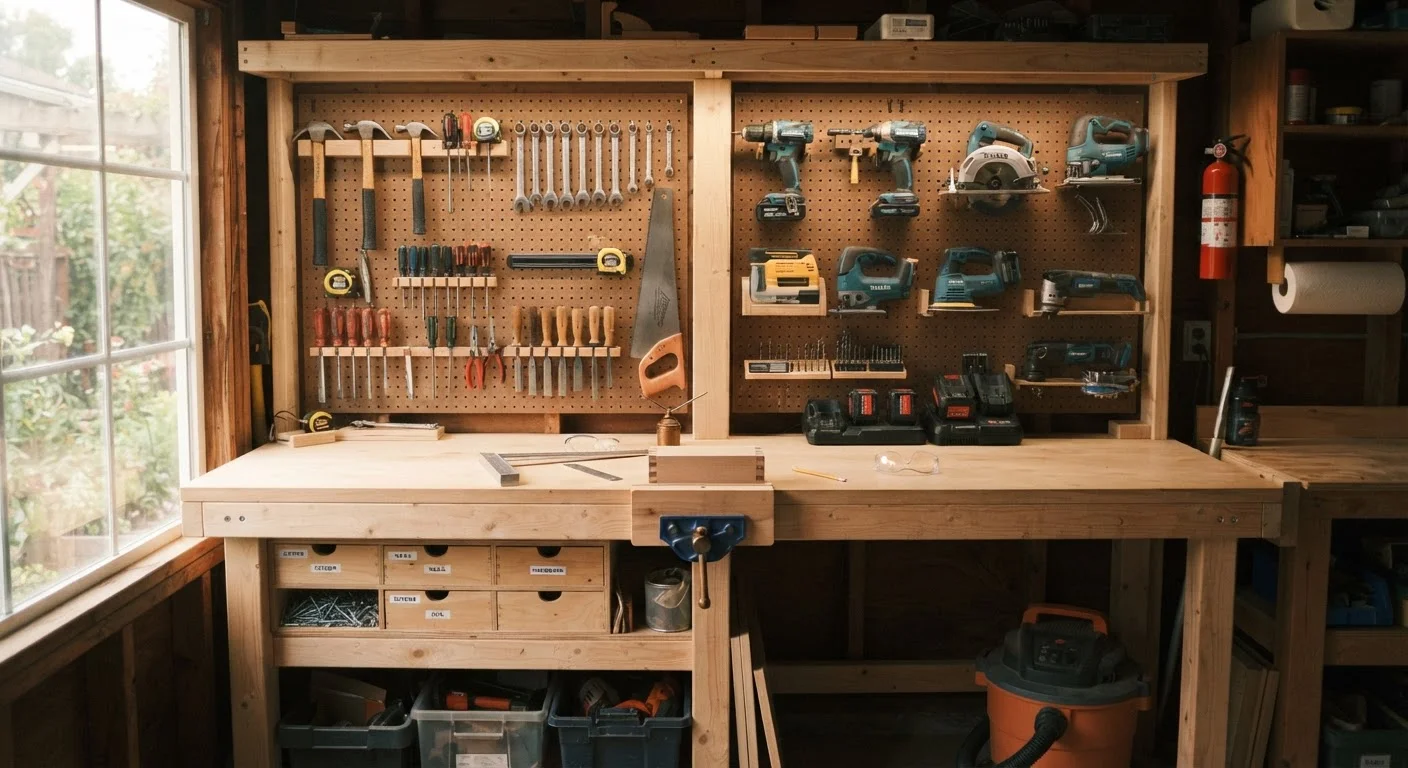
The most cost-effective approach for most homeowners isn't choosing one category over the other - it's building a core set of both. Start with versatile hand tools: a claw hammer, tape measure, combination square, utility knife, block plane, and a crosscut hand saw. Add a set of chisels and a mallet for joinery and hardware work. These cover the majority of small repairs and finish tasks around a typical home.
For power tools, a cordless drill-driver is the single most useful starting point. It handles drilling, driving screws, and - with attachments - stirring materials. A jigsaw and a circular saw expand your cutting capability substantially. Beyond those, additions should be driven by specific project needs rather than general aspiration.
Before any weekend project, running through a checklist of required tools and materials prevents frustrating mid-project supply runs. Our weekend project prep checklist walks you through exactly that process. And for a broader, honest look at DIY tradeoffs, see the balanced truth about DIY projects.