

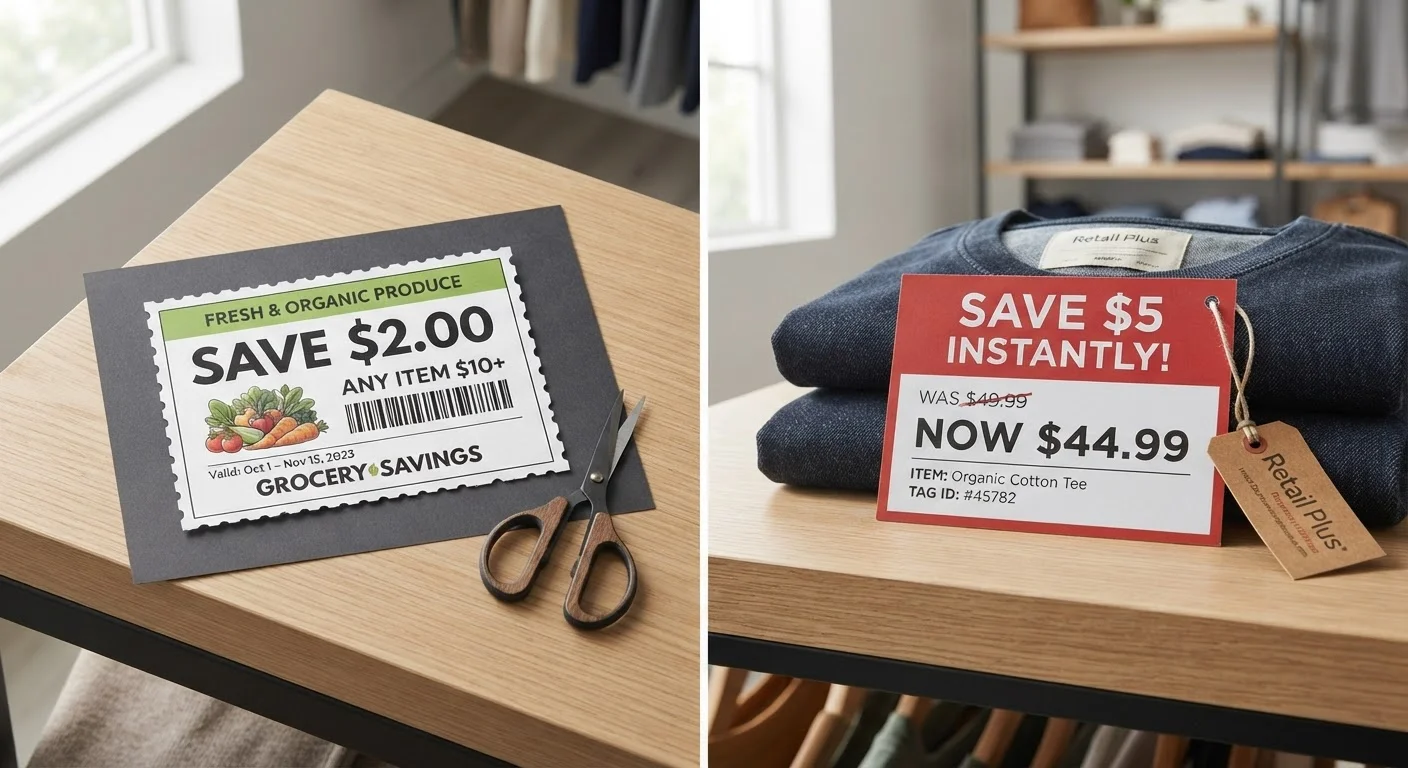
Key Takeaways
- Coupons require active effort to find, organize, and redeem before they expire.
- Instant rebates reduce the sticker price automatically - no codes or paperwork needed.
- Neither method is universally superior; the better choice depends on what you're buying and how you shop.
- Stacking coupons on top of sale prices can sometimes outperform instant rebates on the same item.
- Retailers design both tools to influence purchase behavior - understanding that helps you stay in control.
Option A
Coupons
The shopper-activated, effort-required savings method.
Best for: Shoppers who plan purchases in advance and are willing to track, clip, and redeem discounts manually.
Option B
Instant Rebates
The automatic, point-of-sale price reduction.
Best for: Shoppers who want frictionless savings applied automatically without any additional steps at checkout.
If you shop with a list and plan purchases a week or more out
Coupons
Planning ahead gives you time to source relevant coupons, which can deliver larger percentage savings - especially on groceries and household staples.
If you make frequent unplanned or impulse purchases
Instant Rebates
Instant rebates require zero preparation and deliver real savings even when you haven't done any coupon hunting beforehand.
If you want to maximize savings on a single high-value item
Coupons
Coupons can sometimes be combined with other promotions, whereas instant rebates are generally fixed and non-stackable.
If you shop across multiple retail channels including online
Instant Rebates
Many online retailers apply instant rebates site-wide, requiring no extra steps - making them more consistently accessible across channels.
How Each Discount Mechanism Actually Works
At first glance, coupons and instant rebates both shave money off your purchase. But their mechanics are quite different - and those differences matter when you're trying to stretch a family budget.
Coupons are discount instruments - physical or digital - that a shopper must actively obtain, present, and redeem. They may come from manufacturer mailers, retailer apps, newspaper inserts, or third-party aggregator sites. Each coupon specifies a qualifying product, a discount amount or percentage, and an expiration date. If you forget to apply it before checkout, the savings disappear entirely.
Instant rebates, by contrast, are price reductions built directly into the shelf price or automatically applied at the point of sale. When a retailer or manufacturer runs an instant rebate promotion, the discounted price is what you see - and pay - without any additional action on your part. There's no code to enter, no form to submit, and no deadline to track.
Worth noting: instant rebates are different from mail-in rebates, which require you to submit proof of purchase after the fact and wait weeks for a check or prepaid card. That delay, and the effort involved, means mail-in rebates have a significant non-redemption rate. Instant rebates have no such lag. If you want to understand how these differences affect your final bill, see why your cart total can change at checkout.
| Criterion | Coupons | Instant Rebates |
|---|---|---|
| Effort required | High - must find, track, and apply | None - applied automatically |
| Expiration risk | Yes - expires if not used in time | No shopper deadline to manage |
| Stackability | Sometimes stackable with other offers | Typically non-combinable |
| Common categories | Groceries, personal care, household | Electronics, appliances, seasonal goods |
| Savings transparency | Variable - depends on coupon found | Clear - visible on shelf or listing |
| Risk of unused savings | High - forgotten coupons save nothing | Low - discount is automatic |
Where Each Type Tends to Win
The honest answer is that neither tool dominates across all situations. Their effectiveness shifts based on product category, how disciplined your shopping habits are, and what the retailer is actually trying to accomplish with the promotion.
Coupons tend to perform better when:
- You buy the same branded items regularly and can reliably find coupons for them.
- You're willing to match coupons against sale prices, which is where the math can get genuinely compelling.
- The coupon covers a high-margin item where manufacturers have room to discount deeply.
Instant rebates tend to perform better when:
- You're purchasing electronics, appliances, or seasonal goods where retailers apply them store-wide.
- You shop without a detailed list and can't predict which coupons to bring.
- The rebate applies to items you'd buy regardless of any promotion.
One consistent watchout for both: promotions are designed to drive purchasing behavior. A coupon for a product you wouldn't normally buy, or an instant rebate on a size you don't need, doesn't actually save you money - it costs you money you wouldn't have spent. Our analysis of common shopping myths that cost families real money covers this dynamic in more detail.
~47%
Mail-in rebate non-redemption rate
Industry estimates have historically placed mail-in rebate non-redemption rates between 40% and 60%, according to consumer advocacy research - a key reason instant rebates are considered more reliable.
3 in 5
Shoppers who buy unplanned items due to discounts
Consumer behavior research consistently finds that promotional pricing - including coupons and instant rebates - frequently drives purchases of items not on a shopper's original list.
Stacking, Combining, and Where Limits Apply
One area where coupons have a structural edge is their potential to stack with other discounts. Some retailers allow a manufacturer coupon and a store coupon to be used on the same item simultaneously. When that's combined with a clearance or weekly sale price, the cumulative savings can exceed what any instant rebate alone would offer.
Instant rebates, however, are typically fixed and non-combinable. Retailers set the promotional price and that's the ceiling - there's usually no mechanism to layer additional discounts on top. This is especially common in electronics promotions, where the instant rebate is the entire promotional structure for that product cycle.
If grocery spending is where your family budget feels most squeezed, it's worth reading about grocery budget strategies that hold up in real kitchens - coupons tend to play a more active role in that category than in other retail segments.
Also consider channel: in-store versus online pricing can affect which discount type is even available to you on a given item. Some instant rebates are exclusive to in-store purchases; some digital coupons only apply online.
Finally, both tools can encourage buying more than you need. Before using either, it's worth checking the math on multi-buy and bulk offers to make sure you're not over-purchasing in the name of savings.