

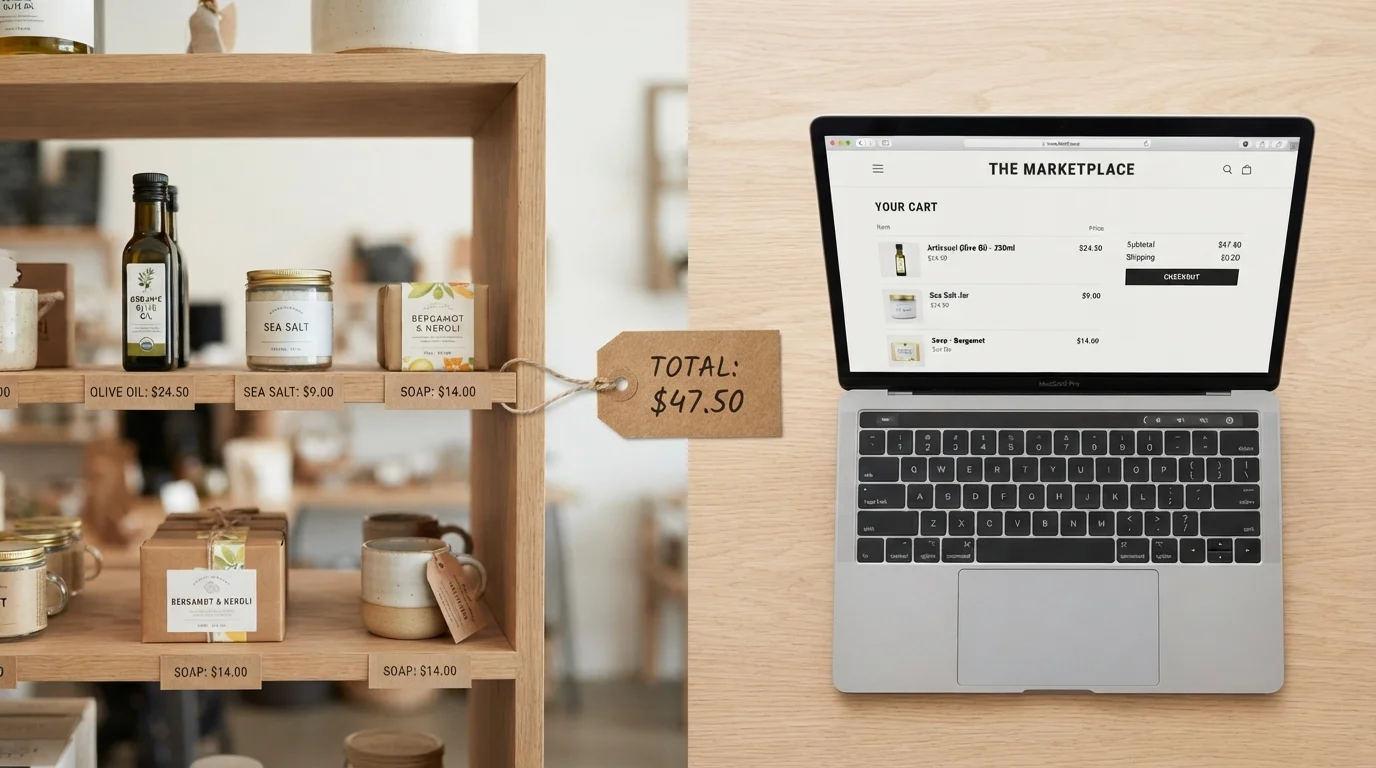
Key Takeaways
- Neither channel consistently wins on price - it depends on the product category and timing.
- In-store exclusives and clearance markdowns can undercut online prices significantly.
- Online tools let you verify whether a deal is genuine before you buy.
- Shipping costs and return friction can offset apparent online savings.
- Retailers use different pricing strategies per channel to manage demand and inventory.
- Cross-checking both channels before purchasing is the most reliable way to find real value.
Option A
In-Store Shopping
The tactile, immediate, sometimes exclusive channel.
Best for: Shoppers who want to inspect items in person, avoid shipping delays, or take advantage of unadvertised in-aisle promotions.
Option B
Online Shopping
The data-rich, price-transparent, always-open alternative.
Best for: Shoppers who can wait for delivery, want to compare prices across sellers quickly, and prefer tracking price history before committing.
If you're buying perishables, same-day necessities, or fragile items
In-Store Shopping
You avoid shipping damage and delays, and clearance or manager specials often beat online pricing on these categories.
If you're purchasing electronics, appliances, or anything with a long price history
Online Shopping
Price history tools and cross-seller comparison make it far easier to verify you're getting a genuine deal rather than a manufactured discount.
If return likelihood is high (clothing, shoes, furniture)
In-Store Shopping
In-store returns eliminate the cost and hassle of repackaging and shipping, which can quietly erode any online savings.
If you shop during major sale events like holiday weekends
Online Shopping
Online platforms surface competing offers from multiple sellers simultaneously, making it easier to identify which 'deals' are genuinely lower than baseline.
If you use store loyalty programs actively
In-Store Shopping
Many loyalty discounts, member pricing tiers, and instant rebates apply only at the register, not through the same retailer's website.
Why the Same Item Often Has Two Different Prices
Retailers manage in-store and online channels as distinct commercial environments, each with its own cost structure, competitive pressure, and promotional calendar. A grocery chain running a weekend door-buster on paper towels is trying to drive foot traffic - that price may never appear on its website. Conversely, an online retailer that has no physical overhead can sustain lower everyday prices on commodity goods, but layers in shipping fees that close the gap.
Understanding this channel-by-channel logic matters because it shifts the question from "which channel is cheaper?" to "which channel wins for this specific purchase?" The answer changes by category, by retailer, and even by time of year. As our guide on what 'sale' actually means explains, promotional labels don't automatically signal genuine savings - that's true whether you're standing in an aisle or browsing a product page.
| Criterion | In-Store Shopping | Online Shopping |
|---|---|---|
| Clearance pricing | Often deepest in-store only | May not reflect in-store clearance |
| Price transparency | Limited; hard to cross-check | High; history tools available |
| Shipping cost | None | Variable; can offset savings |
| Return ease | Hand back directly | Repackage and ship; fees possible |
| Loyalty program perks | Register-only discounts common | Digital rewards; may differ |
| Unadvertised specials | In-aisle markdowns exist | Rare; usually flagged online |
| Coupon/cash-back stacking | Limited combinations | Easier to stack multiple savings |
| Availability & immediacy | Take home same day | Shipping window required |
Where In-Store Tends to Win
Physical retail has a few reliable advantages that are easy to overlook when you default to searching online first.
- Clearance and end-of-line markdowns are frequently deeper in-store, where retailers need to free up floor and shelf space. These prices may not be replicated online, or the item may not appear there at all.
- Manager or in-aisle specials - unadvertised price reductions - exist in physical stores and carry no online equivalent.
- Loyalty card pricing at the register sometimes differs from online member pricing, particularly at grocery and pharmacy chains.
- Avoiding return friction is a genuine financial factor. If there's any chance you'll need to return the item, the in-store channel often has lower effective cost because you hand it back directly.
In-store also wins on immediacy: no shipping window, no risk of damage in transit, no need to coordinate a delivery. For families with specific timing needs, that has real value. Before assuming a brick-and-mortar price is higher, check whether the retailer publishes in-store-only promotions on its weekly circular - many do, and those prices are not always matched online.
~65%
Shoppers who check online before in-store purchase
Research from the National Retail Federation consistently shows that a majority of consumers research prices digitally before buying in a physical store.
6-12%
Typical price variation between channels
Academic and industry analyses of multichannel retail pricing have found that the same product can differ by this range between a retailer's in-store and online prices, depending on category.
30%+
Online return rate for apparel
Retail industry estimates suggest clothing bought online is returned at significantly higher rates than in-store purchases, a cost factor often overlooked when comparing channel prices.
Where Online Tends to Win
Online shopping's clearest structural advantage is transparency. With price comparison tools and price history extensions, you can verify within minutes whether today's listed price is actually lower than the historical norm - something nearly impossible to do at a store shelf.
- Cross-seller comparison is frictionless online. Checking three or four sellers for the same item takes seconds, whereas doing this across physical stores is impractical.
- Price history verification protects against anchor pricing - the tactic of showing a crossed-out "was" price that may not reflect a genuine prior selling price. Our explainer on anchor pricing walks through exactly how this works.
- Lower everyday prices on commodity goods - high-volume, standardized products like batteries, cables, or non-perishable household supplies - tend to be more competitive online due to reduced overhead.
- Stacking digital coupons and cash-back portals is generally easier online, adding layers of savings that physical stores rarely match in combination.
The catch: always calculate the total landed cost, including shipping, handling, and any restocking fees on returns. A $12 savings on a product with $9 standard shipping and a non-free return policy may represent little actual benefit. For a deeper look at how to verify whether a price is genuinely lower, see our guide to spotting a genuine deal.
A Practical Framework for Choosing Your Channel
Rather than defaulting to one channel, a repeatable decision process protects your budget more reliably.
- Check the weekly circular first for in-store-specific promotions, especially on groceries, household goods, and seasonal items.
- Use a price history tool before purchasing online to confirm the listed price isn't inflated from a prior artificial high.
- Calculate total landed cost: add shipping, subtract any applicable cash-back, and factor in return probability.
- Factor in loyalty program structure: some programs pay out differently depending on whether the transaction is in-store or online, even at the same retailer.
The habits that separate consistent value-finders from reactive deal-chasers are documented in our deal-finding strategies guide, which covers how these principles apply across product categories from groceries to appliances. And if you want to pressure-test your overall shopping assumptions, our piece on shopping myths that cost families real money challenges several widely held beliefs that don't hold up once you run the numbers.
Price Matching Policies Can Bridge the Gap
Many large retailers offer price-matching policies that let you claim an online price while purchasing in-store, or vice versa. Policies vary widely: some require a competitor's current listed price, others match only their own channel. Always ask about the specific terms at the point of purchase, and keep in mind that price-match requests typically require you to present evidence of the lower price at the time of the transaction.
This article is for general informational purposes. Pricing practices vary by retailer and region. Always verify current prices and policies directly with the retailer before making purchasing decisions.