
Guest Checkout vs. Creating an Account: Privacy, Convenience, and What You Give Up

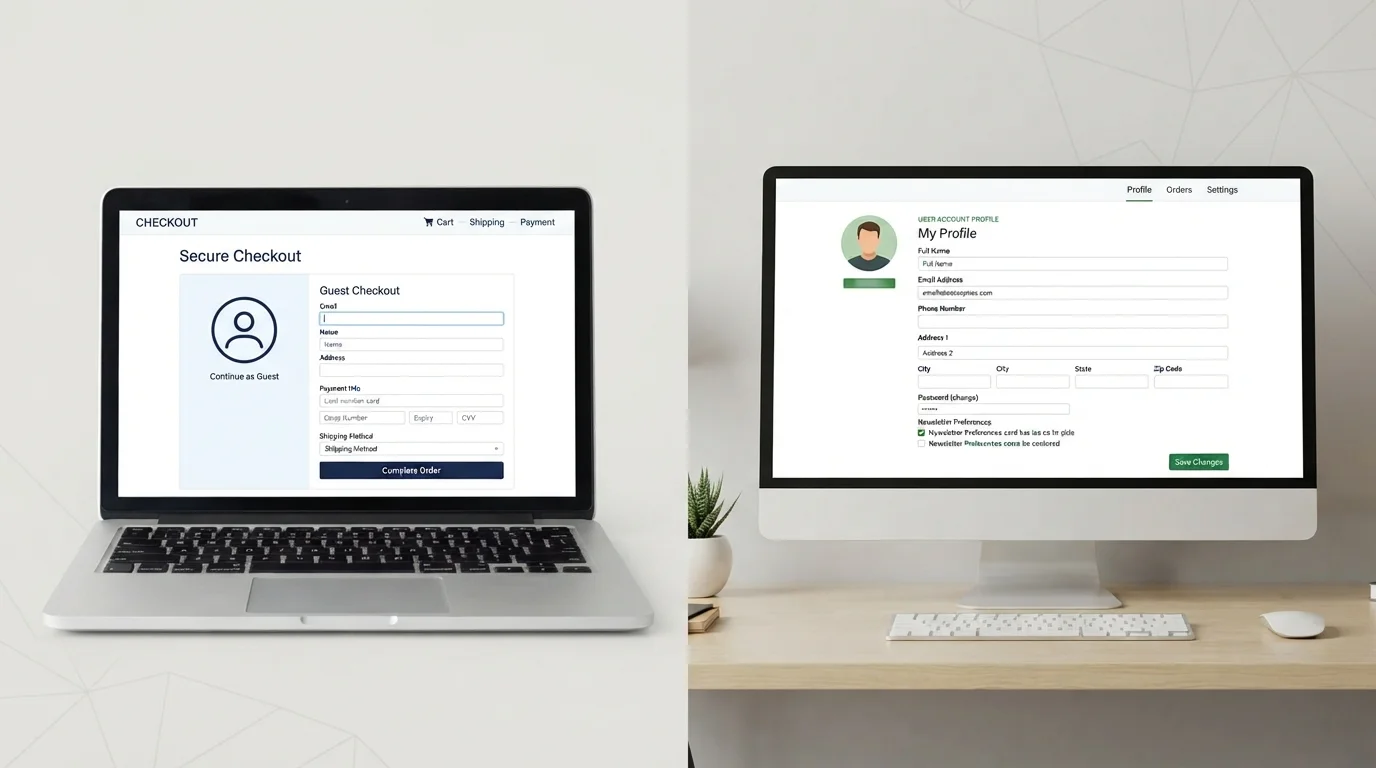
Key Takeaways
- Guest checkout limits the personal data a retailer stores about you long-term.
- An account speeds up repeat purchases but ties your data to that retailer's systems.
- Marketing emails and data-sharing practices are the biggest practical differences between options.
- Your payment details may be stored either way if the retailer's system auto-saves them - always check.
- For unfamiliar sites, guest checkout is generally the lower-risk starting point.
Option A
Guest Checkout
The low-commitment, privacy-first option.
Best for: Shoppers making a one-time purchase on a site they may never use again, or anyone prioritizing data minimization.
Option B
Creating an Account
The convenience-focused, long-term option.
Best for: Frequent shoppers who want faster checkouts, order history, and easier returns on sites they trust and revisit.
If you're shopping on a site for the first time
Guest Checkout
You haven't yet established trust with the retailer, and limiting your data footprint reduces exposure if their systems are compromised.
If you shop on the same site multiple times a month
Creating an Account
Saved addresses and payment methods save real time, and order history makes returns and warranty claims straightforward.
If you want to minimize marketing emails
Guest Checkout
Account holders are typically auto-enrolled in promotional communications, which requires active opt-out to stop.
If you need to track a return or manage a subscription
Creating an Account
Account dashboards give you direct access to order status, return labels, and subscription controls without contacting support.
If a data breach on the retailer's site concerns you
Guest Checkout
Guest transactions create less persistent data tied to your identity, reducing what could be exposed in a breach scenario.
What Actually Happens When You Choose Each Option
When you check out as a guest, you enter your shipping and payment details for that transaction only. In most cases, the retailer does not create a persistent profile linking your name, address, and purchase history - though some platforms do temporarily store transaction data for order fulfillment. Once the order ships and any return window closes, your exposure is largely limited to that single event.
Creating an account means the retailer stores your details in a customer profile: email, shipping addresses, purchase history, and often saved payment methods. That profile may be used for personalized marketing, shared with affiliated companies under the site's privacy policy, or retained indefinitely. Always review a site's privacy policy before registering - specifically what data they collect, how long they keep it, and whether they sell or share it with third parties.
For a broader look at how checkout safety intersects with other e-commerce risks, see our guide to online shopping safety for families.
| Criterion | Guest Checkout | Creating an Account |
|---|---|---|
| Data stored after purchase | Minimal; transaction-level only | Full profile retained indefinitely |
| Marketing email risk | Low; no ongoing opt-in | Higher; often auto-enrolled |
| Checkout speed on repeat visits | Slower; re-enter details each time | Faster; saved addresses and cards |
| Return and order management | Requires confirmation email | Accessible via account dashboard |
| Credential breach risk | None; no login credentials | Present if password is reused |
| Data-sharing exposure | Limited to single transaction | Broader; subject to full privacy policy |
| Best for unfamiliar sites | Yes | Not recommended initially |
The Privacy Reality: What You Give Up Either Way
Neither option is perfectly private. Whether you check out as a guest or register, you're still entering a name, email, shipping address, and payment information - all of which the retailer receives and processes. The key difference is persistence: how long that data lives in their systems and what it's used for afterward.
Account holders are more vulnerable to a particular type of risk called credential stuffing, where attackers use username-and-password combinations leaked from one site to access accounts on others. This is why, if you do create accounts, using a unique password and enabling two-factor authentication on each site matters. Guest checkout sidesteps this attack vector entirely since there's no account to compromise.
Privacy Policies Vary Widely
There is no universal standard for how long retailers retain guest transaction data. Some delete it after order fulfillment; others keep it for years for fraud-prevention purposes. If data retention matters to you, look for the retailer's privacy policy - usually linked in the site footer - before completing any purchase, guest or otherwise. Most US states now give residents some right to request deletion of personal data under state privacy laws, though the process varies.
Payment data deserves separate attention regardless of your choice. Some retailers auto-save your card details even during guest checkout unless you explicitly opt out. Look for a checkbox labeled something like "save card for future purchases" and uncheck it if you prefer not to store that information. Our comparison of payment method protections explains how your choice of card type also affects your fraud coverage.
Convenience Trade-Offs Worth Knowing
The practical upside of an account is most visible over multiple purchases. Saved addresses eliminate re-entry errors, order history makes warranty claims easier, and some retailers let account holders initiate returns directly from a dashboard rather than hunting for an emailed receipt. If you're a frequent buyer at a particular retailer, the friction reduction is real.
Guest checkout's convenience cost shows up most clearly at return time. Without an account, you're dependent on the confirmation email for order details. Lose that email and retrieving your order information may require a customer service call. Before completing any guest purchase, save or print the confirmation email immediately.
Unexpected charges at checkout - from auto-applied memberships to shipping minimums - are worth understanding regardless of which checkout path you take. See our article on why your cart total looks different at checkout for what to watch for before you finalize any order.
~24%
Share of data breaches involving customer credentials
Verizon's Data Breach Investigations Report consistently identifies stolen credentials as one of the leading factors in breaches affecting retail and e-commerce platforms.
~72%
US consumers concerned about online data privacy
Pew Research Center surveys have repeatedly found that the majority of Americans feel their personal data is less secure online than it was a decade ago.