

Key Takeaways
- Adjusting thermostat schedules around your family's actual routine can reduce heating and cooling costs noticeably.
- Peak-rate electricity billing means the time of day you run appliances directly affects your bill.
- Sealing air leaks and improving insulation often delivers a faster return than upgrading major appliances.
- Water heating is one of the largest energy expenses in most homes and is frequently overlooked.
- Small behavioral shifts - shorter showers, full dishwasher loads - compound into significant annual savings.
Why Utility Bills Deserve a Second Look
For most US families, utility costs - electricity, natural gas, water - rank among the top five monthly expenses. Yet unlike groceries or subscriptions, they rarely get a line-by-line audit. The result is that households often overpay for years without realizing it, not because of one big inefficiency but because of dozens of small, unexamined habits.
The strategies below don't require major renovations or upfront investment. Most are behavioral or low-cost adjustments that work with your existing home and lifestyle. They're drawn from publicly available guidance from the U.S. Department of Energy and the EPA's ENERGY STAR program - not from any single product or vendor. For context on how utility savings fit into a broader spending review, see our guide to trimming recurring household costs.
Use programmable or smart thermostat scheduling
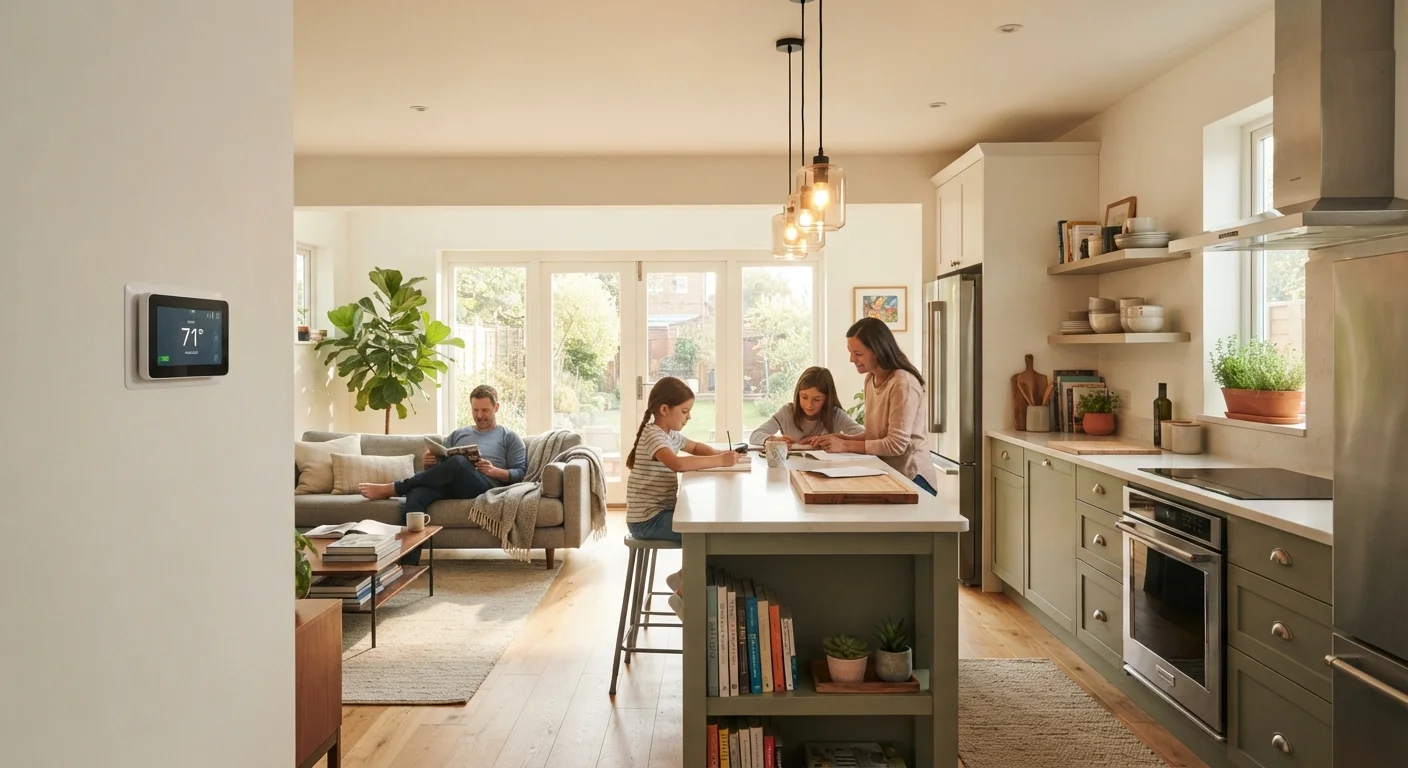
Heating and cooling typically account for roughly half of a home's total energy use, according to the U.S. Department of Energy. The simplest lever is temperature scheduling - setting your thermostat to automatically dial back during hours when your family is asleep or out of the house.
A setback of 7-10°F for eight hours a day (overnight and during school/work hours) can reduce annual heating and cooling costs by around 10%, according to DOE estimates. You don't need a Wi-Fi-connected device to do this - a basic programmable thermostat achieves the same result.
Temperature setbacks during sleep and school hours can cut heating and cooling costs by roughly 10%.
Understand your utility's peak and off-peak pricing
Many electric utilities use time-of-use (TOU) billing, meaning the rate you pay per kilowatt-hour varies by time of day. Running the dishwasher, washing machine, or dryer during on-peak hours - typically mid-afternoon to early evening - costs more than running them at night or early morning.
Check your utility bill or provider's website to see whether TOU pricing applies to your account. If it does, shifting heavy appliance use outside peak windows can reduce your electricity charges without any change to what you're washing or how often.
Shifting appliance use outside peak billing hours costs nothing and can meaningfully reduce your electricity charges.
Seal air leaks before upgrading equipment
Drafts around windows, doors, electrical outlets, and attic hatches allow conditioned air to escape year-round, forcing your heating and cooling system to work harder. The EPA estimates that sealing and insulating a home can save an average of 15% on heating and cooling costs.
Weatherstripping, door sweeps, and foam outlet gaskets cost a few dollars per item and can be installed without professional help. Caulking gaps around window frames is similarly inexpensive. These fixes often deliver a faster return than replacing appliances or HVAC equipment. For a broader view of where to focus home maintenance spending, see our guide to prioritizing home maintenance on a tight budget.
Air sealing often delivers a faster return on investment than replacing major appliances or HVAC equipment.
Lower your water heater temperature
Water heating is typically the second or third largest energy expense in a US home, after space conditioning. Many water heaters are factory-set to 140°F, which is higher than needed for most household uses and increases standby heat loss throughout the day.
The DOE recommends 120°F as a safe and efficient setting for most households. Turning the dial down to 120°F can reduce water heating costs by 4-22%, depending on your usage and equipment. This takes under five minutes and requires no tools in most cases - though if you're unsure about accessing your water heater's controls, a licensed plumber can assist.
Setting your water heater to 120°F is a five-minute change that can reduce water heating energy use noticeably.
Run full loads and use cold-water wash cycles
Washing machines use roughly the same energy per cycle regardless of load size, so running half-full loads doubles the energy spent per item of clothing. The same logic applies to dishwashers. Consistently running full loads is one of the simplest ways to cut per-use energy and water consumption.
Switching from hot to cold water for laundry also matters: approximately 75-90% of the energy used in a wash cycle goes toward heating the water, not running the machine's motor. Modern detergents are formulated to clean effectively in cold water, so comfort and cleanliness are not compromised.
Up to 90% of washing machine energy goes to heating water - switching to cold cycles is an immediate saving.
Address phantom load from idle electronics
Devices that stay plugged in - televisions, gaming consoles, phone chargers, desktop computers - draw power even when not actively in use. This standby power, sometimes called phantom load or vampire power, can account for 5-10% of a household's electricity use, per Lawrence Berkeley National Laboratory research.
The practical fix is grouping devices onto power strips and switching the strip off when the area isn't in use. This is especially effective for entertainment centers and home office setups where multiple devices run simultaneously. It costs nothing to start and requires no ongoing effort once strips are in place.
Standby power from idle devices can account for up to 10% of household electricity use - power strips help eliminate it.
Building These Habits Into Your Household Routine
The households that see the most consistent savings aren't necessarily the ones who invested the most - they're the ones who made these adjustments systematic. Setting a programmable thermostat schedule takes about ten minutes and saves energy every day without anyone thinking about it again. Checking for air leaks once a year before winter costs almost nothing. Running laundry and dishwashers during off-peak hours becomes second nature within a week.
Request a Free Home Energy Audit
Many US electric and gas utilities offer free or low-cost home energy audits that identify your household's specific inefficiencies. An auditor will check insulation levels, identify air leaks, and review appliance efficiency. The findings give you a prioritized list of improvements rather than guesswork. Check your utility provider's website or call their customer service line to ask whether this program is available in your area.
If your family is working through expenses category by category, utility savings pair well with similar approaches in other areas. The family budgeting hub covers practical frameworks for tracking and reducing spending across all major household categories. And if outdoor water use is a concern, drought-tolerant landscaping principles can meaningfully cut irrigation costs without sacrificing curb appeal.
Utility savings rarely come from one dramatic change. They come from layering modest, durable habits that run in the background of daily life - which makes them far more sustainable than any short-term fix.