

Key Takeaways
- Xeriscaping reduces landscape water use significantly without giving up curb appeal or a usable yard.
- Improving soil structure before planting helps roots access water more efficiently.
- Grouping plants by water need - called hydrozoning - prevents overwatering and underwatering.
- Mulch is one of the most cost-effective tools for retaining soil moisture.
- Native and regionally adapted plants often thrive with little supplemental watering once established.
- Drip irrigation and morning watering schedules dramatically cut waste compared to traditional sprinklers.
What Is Xeriscaping - and Why It Matters
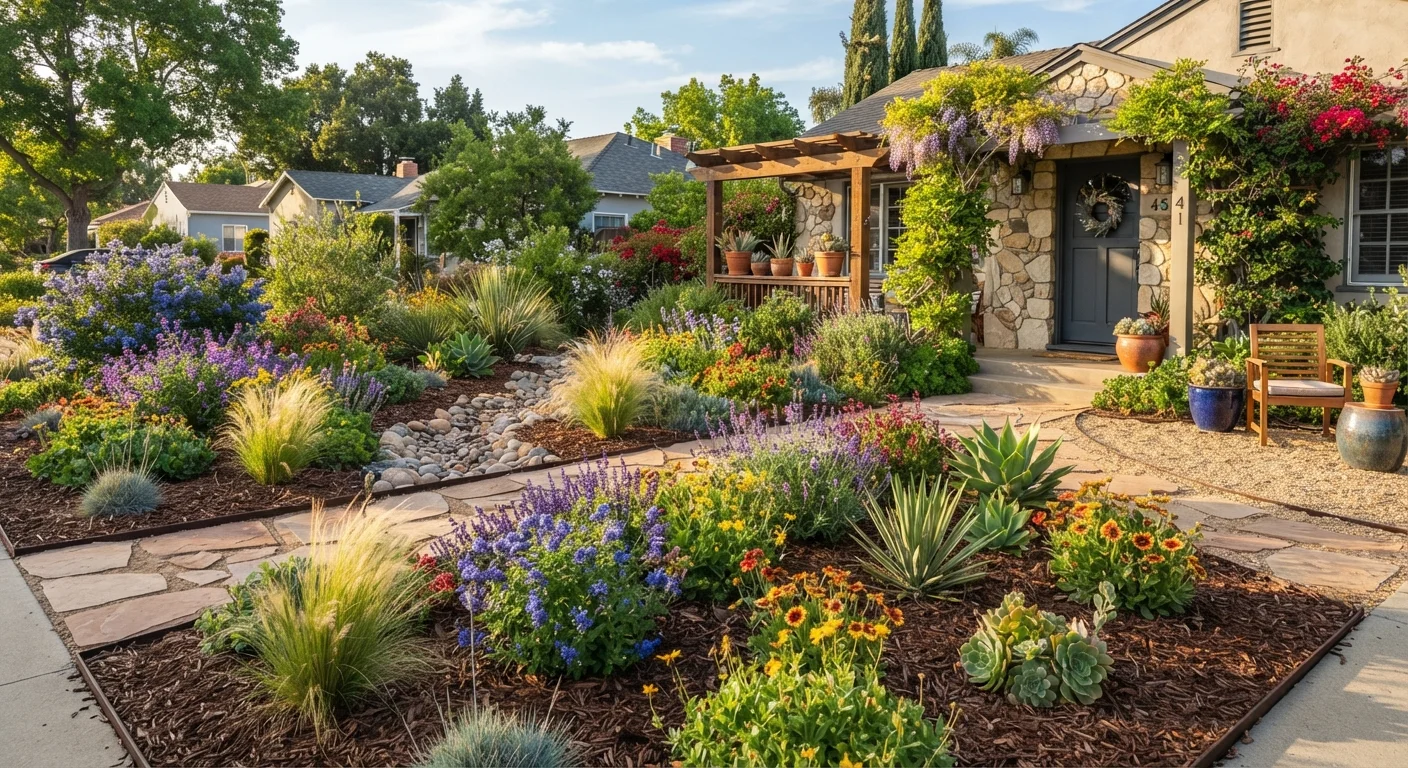
Xeriscaping - from the Greek xeros, meaning dry - is a landscaping approach that minimizes supplemental irrigation by working with your local climate rather than against it. The goal is not a barren gravel lot, but a thoughtfully planted yard that stays healthy through heat and dry spells with far less water than a traditional lawn demands.
Outdoor water use accounts for a substantial share of household water consumption in many parts of the United States, particularly in the West and Southwest. Reducing that footprint can lower water bills and ease pressure on local water supplies - which is why many municipalities actively encourage or even incentivize drought-tolerant landscaping. Check whether your local water utility offers rebates for turf replacement or efficient irrigation upgrades, as programs vary widely by region.
For families working to manage household costs, a water-wise yard also pairs well with broader strategies - see our guide on cutting utility costs without sacrificing comfort for a fuller picture.
Start With Soil: The Foundation of a Water-Wise Yard
Before selecting a single plant, assess what is under your feet. Soil that drains too quickly loses moisture before roots can absorb it; soil that drains too slowly can waterlog roots and promote disease. Both problems undermine a drought-tolerant design before it starts.
A simple jar test - shaking a sample of soil with water and letting it settle - reveals the ratio of sand, silt, and clay. Most yards benefit from working in 2-3 inches of compost to improve both drainage and water retention, whichever direction your soil leans. Compost also feeds soil biology, which helps plant roots go deeper and become naturally more drought-resilient.
When amending soil before planting, work compost in to a depth of at least 6-8 inches rather than just the top inch or two. Roots follow moisture downward, and deeper organic matter encourages that behavior.
Deep root systems are the primary mechanism by which established plants tolerate dry spells; shallow amendment produces shallow roots that stress quickly when the surface dries out.
Buy drought-tolerant plants in smaller pot sizes when possible - 4-inch or 1-gallon starts often establish faster and more robustly than larger transplants, because smaller root systems adapt to new soil conditions more easily.
Larger nursery specimens may look impressive but can experience transplant shock more severely, requiring more supplemental water during establishment and delaying the payoff of drought tolerance.
Aerating compacted soil before amending it allows organic matter to penetrate rather than sitting on the surface. This is especially worthwhile in yards with heavy clay or where foot traffic has packed the ground over years.
Choosing Drought-Tolerant Plants for Your Region
Drought tolerance is not a single trait - it is region-specific. A plant thriving without irrigation in the Pacific Northwest may struggle in Texas, and vice versa. The most reliable starting point is your USDA Plant Hardiness Zone combined with your region's typical summer rainfall patterns.
Plants that are both native to your region and suited to your zone are generally the strongest performers. Native species have evolved alongside local soils, rainfall cycles, and wildlife, meaning they usually need no fertilizer, minimal pruning, and little or no supplemental water once they establish - typically after one to two growing seasons. Our companion article on native plants and why ecologists recommend them explains this in depth.
Beyond true natives, look for regionally adapted ornamentals and groundcovers. Ornamental grasses, lavender, yarrow, black-eyed Susan, Russian sage, and sedums are widely used across a range of climates for good reason - they tolerate dry spells, provide visual interest through multiple seasons, and attract pollinators. Your local cooperative extension office is one of the most reliable (and free) resources for regionally appropriate plant lists.
Mulch, Grouping, and Hydrozoning: Design Principles That Save Water
Three design principles do more to conserve water than almost any other intervention: mulching, thoughtful plant grouping, and hydrozoning.
Mulch
A 2-4 inch layer of organic mulch - shredded bark, wood chips, or straw - over planted beds dramatically slows evaporation from the soil surface, suppresses weeds that compete for moisture, and gradually improves soil as it breaks down. Keep mulch a few inches away from plant stems to prevent rot.
Plant Grouping
Placing plants with similar water needs together is simple in concept but often overlooked. When thirsty annuals are intermixed with drought-tolerant perennials, you end up watering everything to satisfy the neediest plants - wasting water on the ones that would prefer drier conditions.
Hydrozoning
Hydrozoning takes grouping a step further by designing the entire landscape in distinct zones based on water requirement. High-water zones (such as a small vegetable bed or a shaded corner that retains moisture naturally) are separated from medium- and low-water zones, allowing each area to be irrigated - or not - on its own schedule.
Map Your Yard Before You Plant
Before choosing plants or irrigation zones, sketch a simple diagram of your yard noting sun exposure, slopes, and areas that stay wet or dry after rain. This ten-minute exercise reveals natural microclimates that should drive your hydrozoning layout. Placing low-water plants on a south-facing slope and saving shadier, naturally moister spots for any higher-water needs is one of the most effective - and free - design moves available.
Smart Irrigation: Watering Less but Better
Even the most drought-tolerant landscape benefits from efficient irrigation during establishment and during unusually prolonged dry periods. The key is delivering water where it is needed, when it is needed, with minimal loss to evaporation or runoff.
Drip irrigation systems deliver water directly to the root zone at a slow rate the soil can absorb. Compared with traditional spray sprinklers, drip systems can use significantly less water for the same planting area. For guidance on timing - which matters as much as volume - our article on lawn watering schedules and timing covers the principles well.
If you use sprinklers for any remaining turf areas, water early in the morning to reduce evaporation and fungal disease risk. Avoid watering during the heat of the day or in the evening. A simple timer or a smart irrigation controller that adjusts based on local weather data can prevent the most common form of water waste: forgetting to turn the system off after rain.
30-60%
Typical water savings with drip vs. spray irrigation
The U.S. Environmental Protection Agency (EPA) estimates that drip irrigation can be 30-50% more efficient than conventional sprinkler systems for landscape beds.
~50%
Share of household water used outdoors
EPA WaterSense data indicates that roughly half of residential water use goes to landscape irrigation, with much of that lost to inefficiency.
1-2 seasons
Typical establishment time for native plants
Most cooperative extension sources note that native perennials and shrubs generally need one to two growing seasons of supplemental watering before becoming largely self-sufficient.
Reducing or Replacing Turf Grass
Traditional cool-season or warm-season turf grasses are among the thirstiest elements in a residential landscape. Reducing the size of your lawn - or transitioning portions of it to groundcovers, gravel pathways, or planted beds - is often the single largest step toward a water-efficient yard.
You do not need to eliminate grass entirely. A practical approach for many families is to keep a usable, maintained grass area for recreation or play and replace high-maintenance, low-use strips (such as the narrow patch between the sidewalk and street) with drought-tolerant alternatives like creeping thyme, buffalo grass, or ornamental stone with low-water plantings.
If you are reconsidering how much of your yard is devoted to grass, it helps to separate lawn care myth from evidence-based practice first. Our article on common lawn care myths that waste money is a useful companion read before you make changes.
Maintaining a Drought-Tolerant Landscape Over Time
One of the genuine advantages of a well-designed drought-tolerant landscape is reduced ongoing maintenance. Once established - usually after one to two full growing seasons - most native and regionally adapted plants need very little intervention beyond seasonal tidying.
Each year, a few recurring tasks keep the landscape healthy: refreshing mulch as it breaks down, dividing overcrowded perennials, and checking irrigation emitters for clogs or misalignment. These fit naturally into a broader seasonal routine - for a full seasonal framework, see our seasonal yard maintenance task guide.
Resist the urge to fertilize drought-tolerant plantings heavily. Excess nitrogen encourages lush, fast growth that actually increases water demand. A light top-dressing of compost in spring is usually sufficient for most native and adapted plantings. With realistic expectations and a patient establishment period, a drought-tolerant yard can be genuinely lower effort and lower cost than a conventional lawn - season after season.