

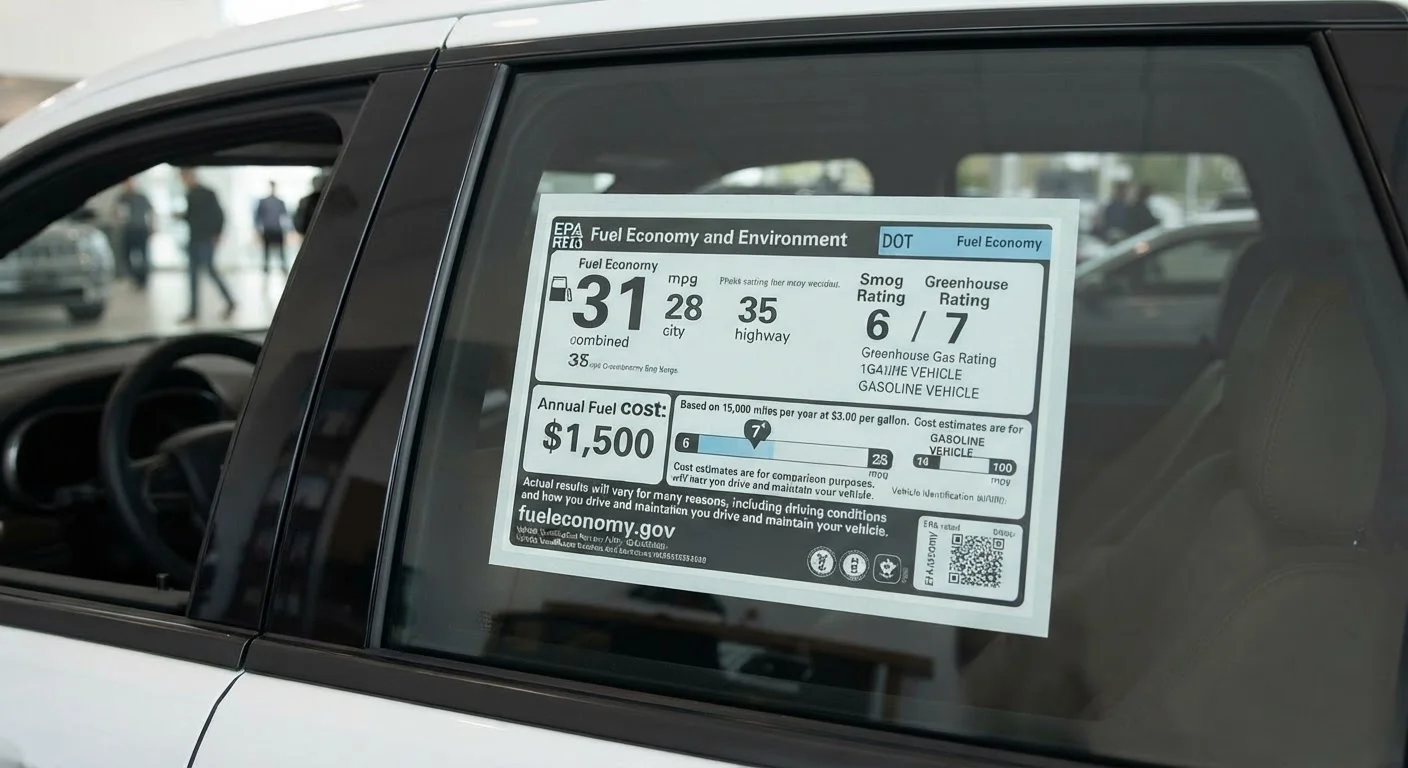
What the Window Sticker Numbers Actually Mean
Every new car sold in the US carries an EPA Monroney label - the window sticker - that displays standardized fuel economy figures. Understanding what those numbers represent is the first step toward estimating your true annual fuel cost and comparing vehicles on equal footing.
MPG (miles per gallon) is the most familiar figure: how many miles your vehicle travels on one gallon of gasoline. A higher number means less fuel consumed per mile. But MPG alone doesn't tell the whole story - where you drive matters just as much as how efficient the vehicle is rated.
The EPA measures fuel economy under three separate driving scenarios, each weighted differently to produce the sticker figures you see:
- City MPG - Simulates stop-and-go urban driving with frequent braking and lower average speeds. Typically the lowest of the three figures.
- Highway MPG - Simulates sustained cruising at higher speeds with minimal stops. Usually the highest figure on the sticker.
- Combined MPG - A weighted average of city and highway, calculated as 55% city and 45% highway driving. This is the headline figure most often used for comparison.
If your commute is mostly city driving, your real-world fuel costs will more closely track the city number than the combined figure. Families who do a lot of highway travel will generally see better real-world efficiency than the combined estimate suggests.
MPGe, kWh, and the Language of Electric and Hybrid Vehicles
As more households consider electrified vehicles, new terms appear on window stickers that can be confusing if you've only ever shopped for gas-powered cars.
MPG
Miles per gallon. The number of miles a vehicle travels on one gallon of fuel. Higher MPG means lower fuel consumption per mile driven.
MPGe
Miles per gallon equivalent. A metric used for electric and plug-in hybrid vehicles that converts electrical energy consumption into the equivalent of gasoline for standardized comparison.
Combined MPG
A weighted average of city and highway fuel economy figures, calculated as 55% city and 45% highway. This is the primary figure displayed on EPA window stickers.
kWh per 100 miles
A measure of electric vehicle efficiency showing how many kilowatt-hours of electricity are consumed per 100 miles traveled. Lower values indicate greater efficiency.
PHEV
Plug-in hybrid electric vehicle. A vehicle with both a gasoline engine and a battery that can be charged externally, allowing it to operate in electric-only or gas-only mode.
Monroney Label
The federally required window sticker on new vehicles that displays EPA fuel economy ratings, estimated annual fuel cost, and other standardized vehicle information.
MPGe (miles per gallon equivalent) applies to plug-in electric vehicles (EVs) and plug-in hybrids (PHEVs). Because electricity is measured in kilowatt-hours (kWh) rather than gallons, the EPA converts electrical energy to a gasoline equivalent so shoppers can make apples-to-apples comparisons. Specifically, 33.7 kWh of electricity is treated as the energy equivalent of one gallon of gasoline. A higher MPGe means the vehicle uses electricity more efficiently.
kWh per 100 miles is sometimes displayed alongside MPGe for EVs. It works similarly to how some countries use liters per 100 km - a lower number indicates better efficiency. This figure is directly useful when estimating your monthly electricity cost.
For plug-in hybrids, the sticker shows separate figures for electric-only range and gas-only MPG, because PHEVs operate in two distinct modes. How often you plug in dramatically affects your real-world fuel spending - a point covered in more detail in our article on the long-term cost picture for gas vs. electric vehicles.
Estimated Annual Fuel Cost is perhaps the most practically useful number on the sticker. The EPA calculates it using national average fuel prices and an assumed mix of 15,000 miles per year. It's a useful baseline, but your actual cost will vary based on local gas or electricity prices and how many miles you drive.
Why Real-World MPG Differs from the Sticker
EPA test figures are produced under controlled laboratory conditions. Your real-world fuel economy will almost always differ - sometimes significantly. Common reasons include:
- Driving habits: Aggressive acceleration and hard braking reduce efficiency. Smooth, anticipatory driving can meaningfully close the gap with the sticker number.
- Speed: Fuel economy drops noticeably above 60-65 mph for most vehicles. Each additional 5 mph above that range increases fuel consumption.
- Load and cargo: Carrying extra weight - passengers, gear, a loaded roof rack - forces the engine to work harder.
- Climate and terrain: Cold weather reduces efficiency for both gas and electric vehicles. Hilly terrain increases fuel use compared to flat roads.
- Vehicle maintenance: Under-inflated tires, a dirty air filter, or degraded engine oil all reduce efficiency. See our guide on car maintenance myths that cost drivers money for more on what actually affects performance.
The EPA also publishes a MPG range on stickers (for example, "Most drivers achieve between 22 and 30 MPG") that accounts for real-world variability. Pay attention to this range, not just the single combined figure.
If reducing fuel costs is a priority, small adjustments to driving habits and tire pressure can produce noticeable savings without requiring a new vehicle.
This article provides general educational information about fuel economy ratings. Actual fuel costs and vehicle performance vary by individual driving conditions and should not be taken as a guarantee of any specific outcome. Consult your vehicle's owner's manual and the official EPA fuel economy resources for figures specific to your vehicle.