

Key Takeaways
- Electric vehicles typically cost more upfront but less per mile to fuel and maintain over time.
- The break-even point varies widely based on driving habits, local electricity rates, and purchase incentives.
- Gas vehicles carry lower sticker prices but higher long-term fuel and maintenance costs on average.
- Federal tax credits and state incentives can meaningfully shift the financial equation for EVs.
- Neither option is universally cheaper - your annual mileage and local conditions matter most.
Our Verdict
Neither gas nor electric vehicles win outright on cost - the answer depends on how much you drive, where you live, and how long you keep the vehicle. High-mileage drivers in states with low electricity rates and available tax incentives tend to see the clearest long-term savings with EVs. Lower-mileage drivers or those without home charging access may still find gas vehicles more cost-effective overall.
| Best for | Recommended |
|---|---|
| High-mileage drivers with home charging access | Electric Vehicle |
| Budget-conscious buyers prioritizing lower purchase price | Gas Vehicle |
| Families in areas with strong EV incentives and low electricity rates | Electric Vehicle |
| Drivers with limited charging infrastructure nearby | Gas Vehicle |
Purchase Price and Financing Costs
The sticker price gap between gas and electric vehicles remains significant. As of recent model years, the average new EV has carried a purchase price several thousand dollars higher than a comparable gas-powered model. That difference grows when you factor in financing: a higher loan principal means more interest paid over a typical 60- or 72-month term.
However, federal tax credits - currently up to $7,500 for qualifying new EVs under the Inflation Reduction Act - can offset a meaningful portion of that premium for eligible buyers. Income limits and vehicle price caps apply, so not every buyer qualifies. Some states layer additional rebates on top. Before assuming you'll capture the full credit, verify eligibility through IRS guidance or a tax professional.
For a fuller picture of what you're really committing to financially, see the true cost of owning a car beyond the sticker price, which covers depreciation, insurance, and other ownership layers often missed at the point of sale.
Fuel Costs: Electricity vs. Gasoline
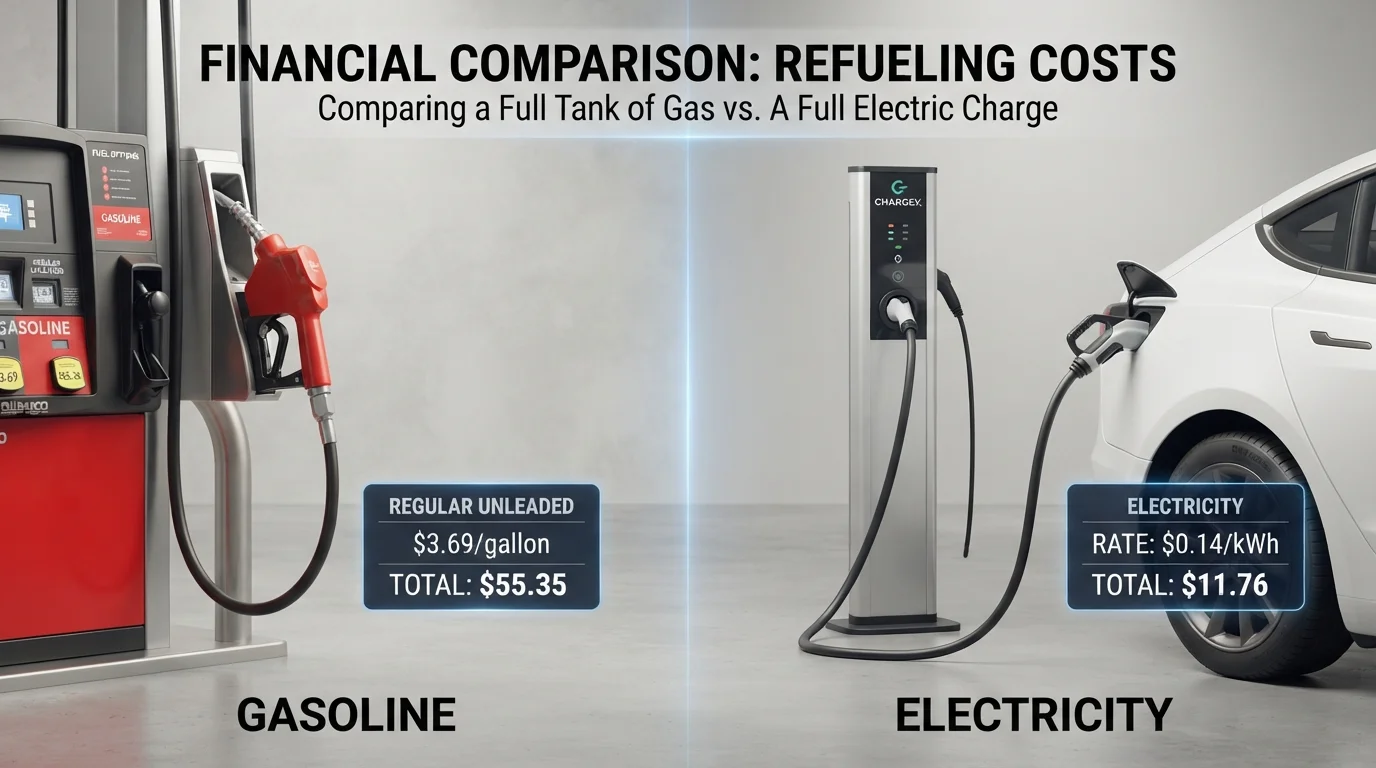
This is where EVs tend to build their long-term advantage. The U.S. Department of Energy has estimated that the per-mile fueling cost for an electric vehicle is generally lower than for a gasoline vehicle - often by a factor of two or more - though the exact gap depends heavily on local gas prices and your utility rate.
Charging at home overnight on a standard rate is typically the most economical option. Public fast-charging, especially on premium networks, narrows that gap considerably and can sometimes approach gas costs per mile. If you lack home charging access and rely primarily on public infrastructure, the fuel-cost savings case for EVs weakens.
Annual mileage is the amplifier. A driver covering 15,000 miles per year will accumulate fuel savings much faster than one driving 7,000 miles. Understanding fuel economy terms every driver should understand - including MPGe, the electric equivalent of MPG - helps you compare vehicles on an apples-to-apples basis.
~$0.03-$0.05
Estimated EV cost per mile (electricity)
The U.S. Department of Energy estimates electric fueling costs at roughly half or less of gasoline on a per-mile basis, though local utility rates vary significantly.
$7,500
Maximum federal EV tax credit
The Inflation Reduction Act established this credit for qualifying new EVs, subject to income thresholds and vehicle MSRP caps set by the IRS.
8 yrs / 100K mi
Typical EV battery warranty
Federal regulations require EV manufacturers to warrant the battery for at least 8 years or 100,000 miles, providing some protection against early replacement costs.
Maintenance and Repair Expenses
Electric vehicles have fewer moving parts than internal combustion engines - no oil changes, no transmission fluid, no spark plugs, no exhaust system. Studies from consumer and automotive research organizations have generally found that EV owners report lower scheduled maintenance costs on average.
That said, EVs aren't maintenance-free. Tires, brakes, cabin air filters, and windshield washer fluid still need attention. Battery health is a longer-term consideration: most manufacturers offer battery warranties of eight years or 100,000 miles, but replacement outside warranty can be expensive. Gas vehicles, meanwhile, carry well-understood maintenance schedules and a vast, competitive repair market that keeps routine service costs relatively predictable.
For a category-by-category breakdown of typical ownership expenses, the annual car ownership costs reference breakdown provides a useful baseline for budgeting both vehicle types.
Track Your Real Per-Mile Costs
Keep a simple log of fuel or charging expenses divided by miles driven each month. After three to six months, you'll have an accurate per-mile energy cost specific to your driving patterns and local rates - far more useful than national averages for planning purposes.
Insurance and Depreciation
Insurance premiums for EVs have historically run higher than for comparable gas vehicles, partly due to higher repair costs for specialized components and, in some cases, higher vehicle values. This gap has been narrowing as insurers gain more data and competition increases, but it remains a real line item to budget for.
Depreciation - the largest single cost of new car ownership for most drivers - affects both vehicle types, though patterns differ. Early EV models saw steep depreciation as rapid technology advances quickly aged earlier versions. More recent data suggests depreciation rates are converging, but resale values remain harder to predict for EVs than for established gas models with long track records.
Families weighing a lease instead of purchase should review buying vs. leasing trade-offs - leasing can limit depreciation exposure but changes the long-term math on both vehicle types.
How to Run Your Own Numbers
Generic comparisons are a starting point, not a verdict. Your actual outcome depends on: your state's electricity and gas prices, available incentives, your typical annual mileage, whether you can charge at home, and how long you intend to keep the vehicle.
The U.S. Department of Energy's Vehicle Cost Calculator is a publicly available tool that lets you plug in local fuel prices and driving patterns to estimate total ownership costs for specific models. Running this calculation before purchase is more reliable than relying on national averages.
| Cost Category | Gas Vehicle | Electric Vehicle | |
|---|---|---|---|
| Average Purchase Price | Generally lower | Generally higher by several thousand dollars | |
| Federal Tax Incentives | None for new purchases | Up to $7,500 (income/price limits apply) | |
| Per-Mile Fuel Cost | Higher on average | Lower on average (varies by rates) | |
| Scheduled Maintenance | Oil changes, filters, more frequent | Fewer items; no oil or transmission service | |
| Insurance Premiums | Typically lower | Typically higher, gap narrowing | |
| Long-Term Depreciation | Predictable, established patterns | Less predictable; technology evolving | |
| Charging/Fueling Infrastructure | Gas stations widely available | Home charging ideal; public network expanding |
Costs that often go unbudgeted - registration fees, inspection costs, loan interest, and parking - apply to both vehicle types and can shift the picture further. The costs families frequently underestimate article covers these hidden line items in detail.
This article provides general financial information for educational purposes and does not constitute personalized financial or tax advice. Consult a qualified financial or tax professional regarding your specific situation and eligibility for vehicle incentives.