

Key Takeaways
- Tailgating is a leading contributing factor in rear-end collisions, which are among the most common crash types in the US.
- At 60 mph, a typical vehicle needs roughly 240-300 feet to come to a complete stop under normal conditions.
- The 3-second rule is a practical, speed-independent method for maintaining a safe following gap.
- Wet, icy, or debris-covered roads can double or triple the stopping distance needed.
- Aggressive tailgating is also a recognized trigger of road rage escalation.
- Leaving adequate space ahead gives you options - not just reaction time, but room to steer around hazards.
Tailgating
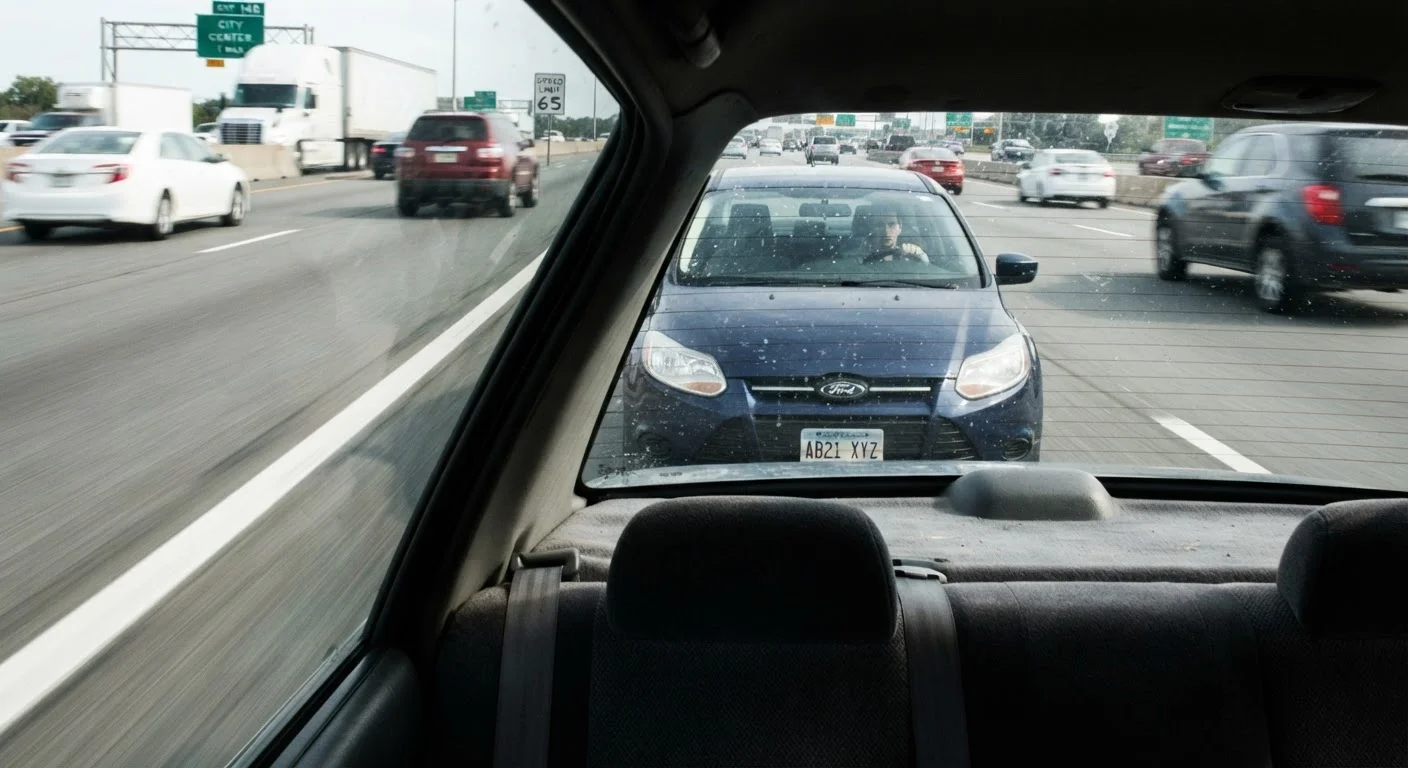
Tailgating means following another vehicle more closely than is safe given your speed, road conditions, and reaction time. It dramatically reduces the time and distance you have to stop if the car ahead brakes suddenly. Most traffic safety experts define a safe following distance as at least three seconds of travel time between your vehicle and the one in front.
Stopping distance is the sum of reaction distance (the distance traveled while the driver perceives and responds to a hazard) and braking distance (the distance the vehicle travels after brakes are applied). Both increase significantly at higher speeds.
The Physics Behind Why Tailgating Is So Risky
Most drivers understand, on some level, that following too closely is dangerous. What many don't appreciate is just how fast the math turns against them.
At 60 mph, your vehicle covers 88 feet every single second. The average driver takes about 1.5 seconds to perceive a hazard and physically press the brake pedal - that's 132 feet of travel before braking even begins. Add braking distance, and a typical car under normal conditions needs 240 to 300 feet to stop completely. If you're two car lengths back, you have roughly 30 feet of cushion. The gap isn't a close call - it's already a collision.
The situation worsens exponentially with speed. Doubling your speed roughly quadruples your stopping distance, not doubles it, because kinetic energy scales with the square of velocity. Highway tailgating isn't just riskier than city tailgating - it's disproportionately more lethal.
~29%
Share of all US crashes that are rear-end collisions
According to the National Highway Traffic Safety Administration (NHTSA), rear-end crashes are consistently one of the most common collision types on US roads.
1.5 sec
Average driver perception-reaction time
Traffic engineering standards commonly use 1.5 seconds as the baseline human reaction time, meaning your vehicle travels significant distance before braking begins.
4x
Stopping distance increase from 30 to 60 mph
Because kinetic energy scales with the square of velocity, doubling your speed roughly quadruples the distance needed to stop - a relationship most drivers underestimate.
Wet or icy pavement compounds everything. Rain reduces friction between tires and road, extending braking distance by 50 percent or more. On ice, that multiplier can be three to ten times the dry-road figure. A following distance that feels comfortable on a clear Tuesday afternoon may be completely inadequate in a Thursday evening rainstorm.
The 3-Second Rule: Simple Math, Real Protection
Traffic safety professionals have long promoted the 3-second rule because it's intuitive, speed-independent, and requires no calculation while driving.
The method: pick a stationary reference point - a highway sign, overpass, or road marking. The moment the vehicle ahead passes it, begin counting: one-one-thousand, two-one-thousand, three-one-thousand. If your front bumper reaches that same point before you finish the count, you're too close. Back off.
The rule works at any legal speed because as speed increases, so does the distance covered in three seconds - automatically scaling your buffer to match your stopping needs. At 30 mph, three seconds equals 132 feet. At 65 mph, it equals roughly 285 feet. Both are appropriate gaps for those speeds.
Adjust Your Gap for Conditions
The 3-second rule is a baseline for ideal driving conditions. Add at least one extra second for rain, reduced visibility, heavy loads, or unfamiliar roads. If you're behind a large truck or vehicle with limited rear visibility, increase your gap further - you need more time to see hazards ahead of them.
In adverse conditions - rain, fog, construction zones, heavy traffic - extend the count to four or five seconds. Large vehicles like trucks and SUVs also carry more momentum and need additional stopping space. If you're towing a trailer, assume you need even more.
For more on how speed perception affects driver behavior in specific environments, see why drivers underestimate speed in school and work zones.
Why Drivers Do It Anyway - and How It Escalates
Tailgating is rarely random. It's often tied to frustration, time pressure, or a mistaken belief that the driver ahead is going too slowly. Traffic psychology research consistently shows that drivers in a hurry overestimate how much time aggressive driving actually saves - and underestimate the risk they accept in exchange.
There's also a social dynamic. Tailgating is frequently used as a form of pressure - an attempt to prompt the car ahead to speed up or move over. This is where tailgating connects directly to road rage. What begins as impatience can escalate into aggressive driving if the driver ahead reacts defensively or refuses to yield. Both parties end up in a more dangerous situation than they started.
See how road rage develops and how to de-escalate it for a closer look at these dynamics.
If someone is tailgating you, the safest response is to avoid brake-checking or reacting with frustration. Signal and move to another lane when it's safe, or gradually ease off the accelerator to widen your own gap to the car ahead - giving yourself more stopping cushion in case the situation changes quickly.
Understanding tailgating is part of a broader picture of proactive driving. The principles behind defensive driving - anticipating hazards, maintaining space, and managing your own emotional state - directly address why tailgating is so common and how to protect yourself from it. Pairing good following distance habits with awareness of blind spots and mirror limitations gives you a much more complete picture of where road hazards actually come from.
This article is for general informational purposes only and does not constitute legal or safety certification advice. Always observe your state's traffic laws and consult official driver safety resources for guidance specific to your situation.