

| Year ESC became federally required (US) | 2012 (all new passenger vehicles) (NHTSA Federal Motor Vehicle Safety Standard No. 126) |
| Year TPMS became federally required (US) | 2008 (NHTSA TPMS Final Rule) |
| AEB adoption commitment | 20 major automakers pledged AEB as standard equipment (NHTSA / IIHS voluntary commitment, announced 2016) |
| Active safety category | Pre-crash systems that help prevent or mitigate collisions |
| Passive safety category | Systems (airbags, seatbelts) that protect occupants during a crash |
Why Modern Safety Tech Matters
The gap between a car built in the 1990s and one built today isn't just horsepower or infotainment - it's the number of electronic systems actively working to prevent a crash. Understanding what each technology does (and what it doesn't do) helps families make better decisions about the vehicles they drive and the habits they build behind the wheel.
No safety system eliminates risk entirely. They're designed to assist an attentive driver, not replace one. For a broader look at staying safe on the road, see our guide on defensive driving principles.
| Year ESC became federally required (US) | 2012 (all new passenger vehicles) (NHTSA Federal Motor Vehicle Safety Standard No. 126) |
| Year TPMS became federally required (US) | 2008 (NHTSA TPMS Final Rule) |
| AEB adoption commitment | 20 major automakers pledged AEB as standard equipment (NHTSA / IIHS voluntary commitment, announced 2016) |
| Active safety category | Pre-crash systems that help prevent or mitigate collisions |
| Passive safety category | Systems (airbags, seatbelts) that protect occupants during a crash |
Core Active Safety Systems Explained
The following technologies appear across a wide range of vehicles - from economy cars to family SUVs. Some have been standard equipment for decades; others are newer and still spreading through the market.
ABS (Anti-lock Braking System)
Prevents the wheels from locking up during hard braking, allowing the driver to maintain steering control. ABS pulses brake pressure automatically - far faster than a driver can pump the brakes manually.
ESC (Electronic Stability Control)
Detects when the vehicle begins to skid or oversteer and selectively applies braking to individual wheels to help the driver maintain directional control. Required on all new US passenger vehicles since 2012.
AEB (Automatic Emergency Braking)
Uses sensors - typically radar, cameras, or a combination - to detect an imminent collision and apply the brakes automatically if the driver does not respond in time. Some systems also detect pedestrians and cyclists.
LDW / LKA (Lane Departure Warning / Lane Keep Assist)
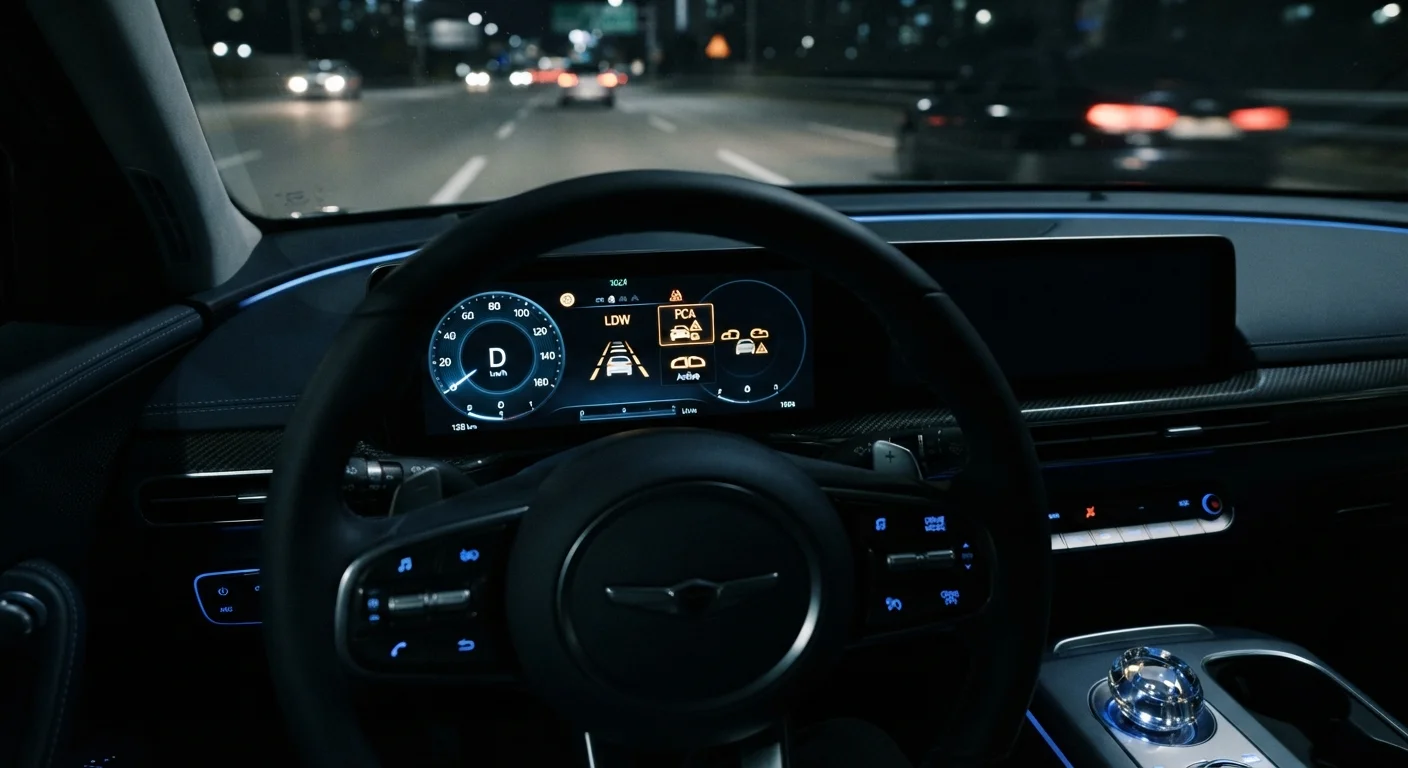
LDW alerts the driver when the vehicle drifts out of its lane without a turn signal. LKA goes further by gently steering the vehicle back toward the lane center.
BSM (Blind Spot Monitoring)
Uses rear-side sensors to detect vehicles in the driver's blind spots and provides a visual or audible alert when the driver signals a lane change.
FCW (Forward Collision Warning)
Monitors the distance and closing speed to the vehicle ahead and alerts the driver - usually with a visual and audible warning - if a collision appears likely. FCW warns; it does not brake automatically (that's AEB's role).
TPMS (Tire Pressure Monitoring System)
Alerts the driver when one or more tires drops significantly below the recommended inflation pressure. Under-inflated tires affect handling, braking distance, and fuel economy. TPMS has been federally required on new US vehicles since 2008.
Adaptive Cruise Control (ACC)
An advanced form of cruise control that uses sensors to automatically adjust the vehicle's speed to maintain a set following distance from the car ahead, rather than holding a fixed speed.
Keep in mind that system names and behavior can vary by manufacturer. Always consult your owner's manual to understand exactly how your vehicle's systems are calibrated. If a warning light tied to any of these systems comes on and stays on, have a qualified mechanic inspect it - don't assume the system is still functioning correctly. Our DIY vs. shop guide can help you decide when a shop visit is the right call.
Passive vs. Active Safety: Understanding the Difference
Safety features fall into two broad categories. Passive systems - like airbags and seatbelts - activate during a crash to reduce injury. Active systems - like ABS, ESC, and AEB - work before or during an incident to prevent the crash from happening in the first place, or to reduce its severity.
Both matter. Passive systems remain critically important because no active technology is perfect. Wearing a seatbelt and using correctly installed child seats still forms the foundation of occupant protection. For guidance on child restraint stages, see child passenger safety seat stages.
Safety Tech Still Requires an Alert Driver
Active safety systems are driver-assist tools, not autonomous replacements for attentive driving. AEB may not detect all hazard types - including debris, animals, or vehicles crossing perpendicularly - and system performance can be reduced by sensor obstructions like heavy rain, snow, or dirt on cameras and radar. Regularly check that sensors and cameras are clean and unobstructed, and don't let the presence of these systems encourage over-reliance or distraction.
If you're ever involved in a collision - regardless of what safety systems fired - knowing your next steps is essential. Our article on what to do after a car accident walks through the process clearly.