

Key Takeaways
- Unstructured outdoor play supports executive function, attention, and emotional regulation in children.
- Nature exposure - even briefly - has measurable calming effects on children's stress responses.
- The American Academy of Pediatrics identifies free play as essential to healthy child development.
- Children benefit from both organized activities and open-ended outdoor time; neither alone is sufficient.
- Budget and space constraints don't have to be barriers - sidewalks, parks, and backyards all count.
Unstructured Outdoor Play
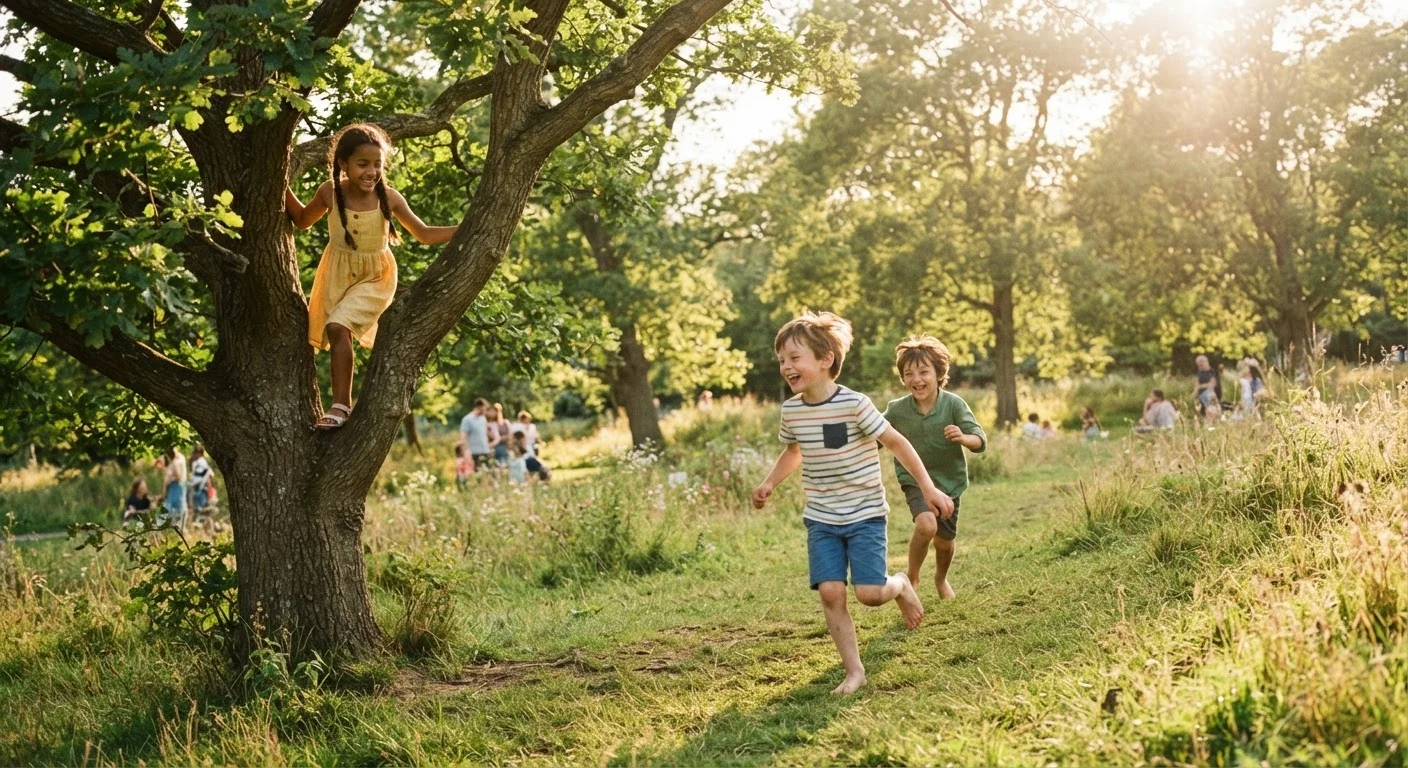
Unstructured outdoor play refers to child-led, free-form activity outside - think climbing, digging, inventing games, or simply exploring a backyard - without adult direction or a predetermined outcome. Unlike organized sports or supervised classes, no one is telling children what to do or how to do it. This freedom is precisely what makes it developmentally valuable.
Developmental researchers distinguish 'free play' from 'structured activity' based on who sets the goals and rules. Child-initiated, intrinsically motivated play is most strongly associated with gains in executive function and social competence.
Why Pediatric Experts Champion Free Play
The American Academy of Pediatrics (AAP) has described play as so fundamental to child development that it considers free, unstructured play a health necessity - not a luxury or a reward for finishing homework. Yet over the past few decades, children's schedules have grown steadily more structured: more organized activities, more screen time, and less open-ended time outside.
This shift has coincided with documented increases in childhood anxiety, attention difficulties, and reduced physical fitness. While no single factor explains these trends, researchers studying child development have accumulated compelling evidence that unstructured outdoor time addresses several of these concerns directly.
It helps to understand why pediatricians and child development specialists draw such a clear distinction between free play and structured activity. In organized settings, adults define the goals, set the rules, and evaluate performance. In free play, children take on those roles themselves - and that internal process is where much of the developmental work happens.
The Simplest Rule: Step Back
The most effective thing parents can do during outdoor free play is resist the urge to organize it. Offering suggestions, setting up activities, or resolving conflicts too quickly all reduce the developmental value of the time. Your job during free play is largely to ensure basic safety and then let children lead - even if what they're doing looks unproductive or repetitive to adult eyes.
What the Research Shows About Cognitive and Emotional Benefits
Executive function - the cluster of mental skills that includes focus, impulse control, and flexible thinking - develops rapidly during early childhood and predicts academic and social outcomes well into adulthood. Studies examining children's play environments have found that child-directed outdoor play is particularly effective at building these skills, in part because it requires children to set their own goals, negotiate with peers, and adapt when things don't go as planned.
Attention is another area with consistent findings. Research conducted across multiple countries suggests that time spent in natural environments - even urban green spaces like parks - is associated with improved attention and reduced symptoms of attention difficulty. One widely cited framework, Attention Restoration Theory, proposes that natural settings engage a softer, involuntary form of attention that allows the directed attention used in classroom and screen-based tasks to recover.
Emotional resilience also appears to benefit. Children who regularly engage in physically challenging, self-directed play - climbing, roughhousing, navigating unfamiliar terrain - encounter manageable risk in a low-stakes context. Developmental psychologists suggest this kind of play helps children learn to assess situations, tolerate uncertainty, and recover from minor setbacks, all of which are precursors to resilience later in life.
60 min
Daily physical activity recommended for school-age children
Per CDC guidelines, children ages 6-17 should get at least 60 minutes of moderate-to-vigorous physical activity each day, most of which can come from active play.
~50%
Decline in children's free play time since the 1970s
Research cited by child development scholars, including work summarized by psychologist Peter Gray, estimates that children's free, unstructured play has dropped substantially over recent decades as scheduled activities and screen time have increased.
20 min
Outdoor exposure linked to improved attention in studies
Studies on Attention Restoration Theory have found that relatively brief periods - as little as 20 minutes - in natural outdoor settings are associated with measurable improvements in children's directed attention performance.
Physical Health: More Than Just Exercise
The physical case for outdoor play is straightforward: children who spend more time in active outdoor environments tend to have better cardiovascular fitness, stronger muscles, and healthier body composition than those who are primarily sedentary indoors. The CDC's physical activity guidelines for children recommend at least 60 minutes of moderate-to-vigorous activity daily, and free outdoor play is one of the most accessible ways to meet that target.
But the physical benefits extend beyond movement. Research on nature exposure and cortisol levels - cortisol being the body's primary stress hormone - suggests that time spent in natural outdoor settings is associated with measurable reductions in physiological stress responses in children. This is meaningful for families navigating busy, high-pressure routines, since chronic stress in childhood has well-documented effects on immune function, sleep, and long-term health.
Outdoor play also promotes sensory development in ways indoor environments often can't. Varied terrain, natural textures, changing light, and unpredictable elements like wind and weather engage a broader range of sensory systems than most indoor play environments, supporting the kind of whole-body physical learning that younger children especially need.
Fitting Free Play Into a Busy Family Life
For many families, the honest barrier isn't awareness - it's time and logistics. Between school, extracurricular commitments, work schedules, and homework, finding a daily window for genuinely unstructured outdoor time can feel like one more thing to manage.
A few practical realities worth keeping in mind: free play doesn't require a special destination, expensive equipment, or a large yard. A sidewalk chalk session, an hour at the neighborhood park, or unscheduled time in a backyard all count. The key ingredient is reduced adult direction - children need space to choose their own activity and set their own pace.
It can also help to reframe the goal. Rather than adding free play to an already full schedule as another obligation, some families find success by protecting one or two existing afternoon slots from being filled with structured activities. The absence of a plan is the point.
For parents curious about how outdoor time fits alongside screen use, our article on screen time and child development offers a grounded look at what the evidence actually says. And if your family travels, choosing family-friendly destinations often comes down to how much outdoor and exploratory space children have access to.
There's no single prescription that works for every family. But the evidence is consistent enough that most pediatric and developmental health organizations treat regular unstructured outdoor time as a meaningful investment in children's long-term wellbeing - one that doesn't require a significant budget or a perfectly structured plan.
This article is for general informational purposes only and is not a substitute for professional medical advice. Always consult your child's pediatrician or a qualified healthcare provider with questions about your child's health or development.