

Key Takeaways
- Not all screen time is equal - content type and co-viewing matter more than raw minutes.
- AAP guidelines are age-specific and more nuanced than a simple 'screens are bad' message.
- Displacement of sleep, movement, and face-to-face interaction is the primary concern.
- Video calls and high-quality educational media carry different risks than passive entertainment.
- Consistent family routines around screens matter more than occasional rule-breaking.
Why Screen Time Debates Feel So Alarming
Few parenting topics generate more anxiety than screen time. Headlines regularly declare that smartphones are harming a generation or that tablets are stunting toddlers - and while those concerns aren't entirely invented, they're often stripped of the nuance that actual researchers apply to their own findings. The result is that many parents feel either paralyzed by guilt or skeptical that any guidance is worth trusting.
The honest picture is somewhere in between: there are real, evidence-based reasons to be thoughtful about how children engage with screens, and there are also significant areas where the panic has outpaced the science. Understanding the difference helps families make grounded decisions rather than reactive ones.
Myth
All screen time is equally harmful to children, regardless of what they're watching or doing.
Fact
Content type, context, and co-viewing make a significant difference in how screens affect children's development.
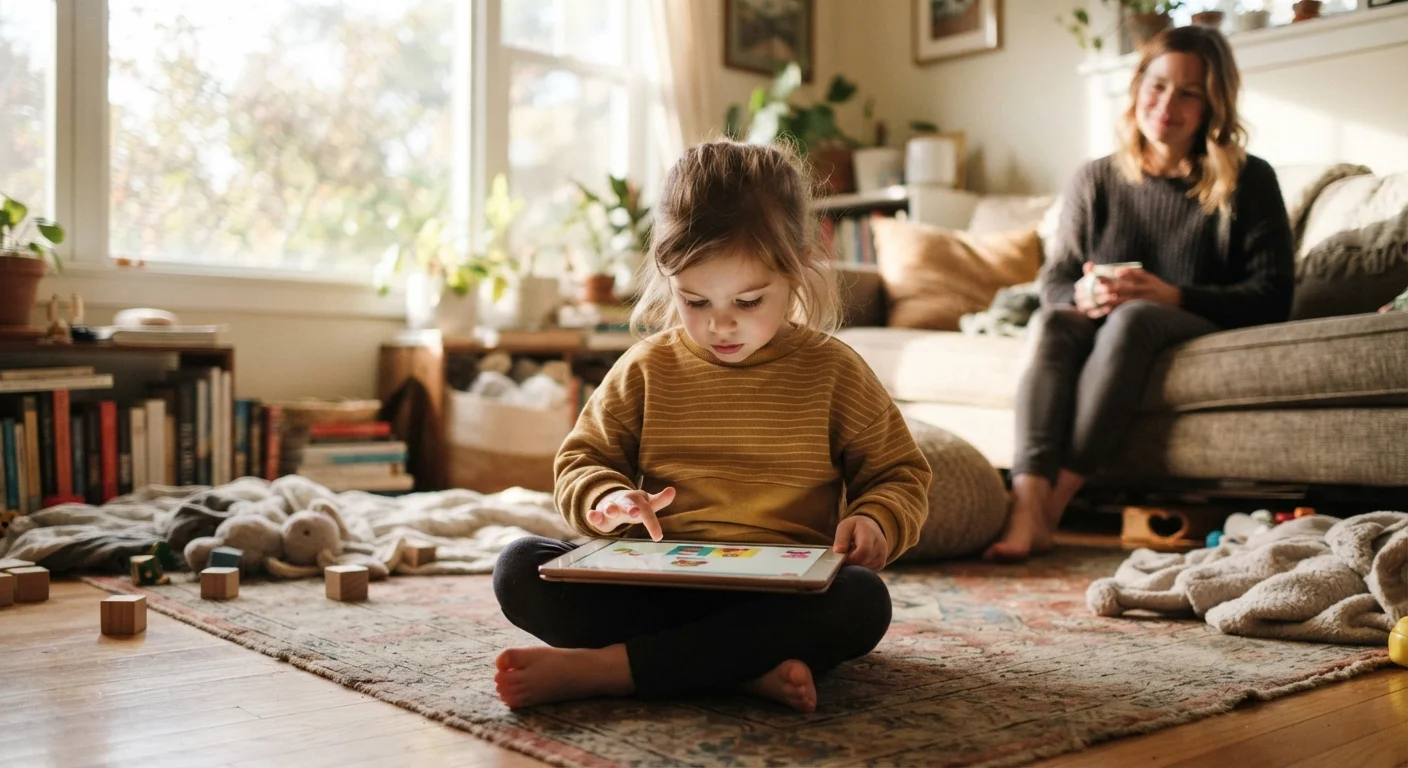
The research consistently shows that screens are not a monolith. A 4-year-old watching an interactive literacy program with a parent is having a fundamentally different experience than a child passively consuming fast-paced cartoon content alone. The American Academy of Pediatrics (AAP) has long emphasized quality and context over raw time limits, particularly for children over age 2. High-quality, slow-paced educational media can support vocabulary and early literacy when a caregiver is present to reinforce the content. The concern isn't the screen itself - it's what it displaces and how it's used.
Myth
The research proves screens cause developmental harm in all children.
Fact
Evidence shows associations - particularly for heavy, unstructured use - but the science is more mixed and uncertain than headlines typically suggest.
Many studies on screens and child development rely on self-reported usage data, short observation windows, and populations that vary widely in income, parenting style, and home environment. Researchers themselves caution that correlation is not causation. A child who logs many screen hours may also have less access to enriching alternatives - making it difficult to isolate the screen effect. That said, associations between very heavy media use and outcomes like reduced sleep quality and reduced physical activity are fairly consistent, which is why the displacement hypothesis - screens crowding out sleep, movement, and conversation - remains the strongest working framework.
Myth
The AAP recommends zero screen time for all children under age 5.
Fact
AAP guidance is age-tiered and carves out specific exceptions, including video calls and quality programming for children 2 and older.
The AAP currently recommends avoiding screens (other than video chatting) for children under 18-24 months, and limiting use to high-quality programming with caregiver co-viewing for ages 2-5. For older children, the focus shifts from strict time limits to ensuring screens don't crowd out sleep, physical activity, homework, and in-person social interaction. Video calls - a staple for many families - are explicitly recognized as a different category because they involve real-time, responsive social interaction. Framing all screens as equivalent overlooks these meaningful distinctions.
Myth
A little extra screen time now and then will cause lasting damage.
Fact
Occasional, contextual screen use is very unlikely to cause harm; what matters are the consistent patterns across weeks and months.
A long car trip, a sick day, or a rainy afternoon with extra TV is not a developmental emergency. Research focuses on habitual, heavy exposure - not isolated instances. Families benefit most from thinking about overall patterns: Are screens regularly displacing bedtime routines? Is dinner conversation being replaced by devices? Are children getting enough outdoor play and reading time most days? Unstructured outdoor time and face-to-face interaction are protective factors worth prioritizing consistently - but one off-day doesn't erase that foundation.
Myth
Social media is the primary screen concern for young children.
Fact
For children under 10, excessive passive video consumption and sleep disruption are the more established concerns; social media risks become more relevant in adolescence.
Much of the public anxiety about screens is shaped by research on teenage social media use, which involves different developmental dynamics than what affects younger children. For kids under 10, the most well-supported concerns center on sleep displacement (especially from bedroom devices and blue-light exposure near bedtime) and reduced time for physical play. Chronic household stress - which shapes children's developing nervous systems in distinct ways - often intersects with heavy media use but is a separate and important variable families should consider alongside screen habits.
What Families Can Actually Do
Rather than chasing perfect compliance with minute-by-minute limits, child health experts generally suggest focusing on a few high-leverage habits:
- Keep bedrooms screen-free, especially in the hour before sleep. Sleep disruption is one of the most consistent findings in the research, and it's one of the most directly addressable.
- Watch together when possible. Co-viewing lets parents ask questions, reinforce learning, and help children process what they see - turning passive consumption into an interactive experience.
- Protect specific offline anchors. Shared family mealtimes and consistent bedtime routines provide predictable screen-free windows without requiring constant negotiation.
- Prioritize physical play. Organized sports and free play each support child development in different ways - both serve as meaningful alternatives to passive screen time.
- Have an honest family conversation. Children who understand why limits exist - not just that they exist - are more likely to internalize healthy habits over time.
This Is General Information, Not Medical Advice
The information in this article reflects general health education based on publicly available guidance from organizations like the AAP and CDC. It is not a substitute for personalized advice from your child's pediatrician. If you have specific concerns about your child's development or media use, please consult a qualified healthcare provider.
For travel days and other situations where screens are a practical tool, planning a mix of activities alongside media use can reduce the total load without eliminating it. Practical, balanced approaches are almost always more sustainable than all-or-nothing rules.
This article is for general informational and educational purposes only. It is not a substitute for professional medical advice, diagnosis, or treatment. Always consult your child's pediatrician with questions about development, behavior, or media habits specific to your child.