

Key Takeaways
- Caulk is designed for stationary gaps; weatherstripping is designed for gaps that open and close.
- Using the wrong material in the wrong location leads to early failure and wasted effort.
- Most homes need both products working together to fully eliminate drafts.
- Caulk applied to a moving door gap will crack and peel quickly from repeated flexing.
- Weatherstripping comes in several types - foam, felt, V-strip, and door sweeps - each suited to different gaps.
- Proper air sealing can meaningfully reduce heating and cooling energy loss in a typical home.
Option A
Caulk
The permanent, flexible sealant for stationary gaps.
Best for: Best for sealing fixed cracks and gaps around window frames, door casings, baseboards, and exterior trim where surfaces don't move.
Option B
Weatherstripping
The compressible seal built for surfaces in motion.
Best for: Best for sealing the moving edges of doors and operable windows where surfaces open, close, and flex repeatedly.
If you're sealing cracks around window frames or door trim
Caulk
These are stationary joints that don't move. Caulk bonds to both surfaces and forms a durable, flexible seal that won't break down from normal household use.
If you're stopping drafts around the edges of a swinging door
Weatherstripping
Door edges compress and release every time the door opens. Weatherstripping is engineered for this movement and will outlast caulk by years in this application.
If you're working on a full window or door weatherproofing project
Both
Use caulk on the fixed frame and trim, and weatherstripping on the operable sash or door edge. Together they eliminate virtually every pathway for conditioned air to escape.
If you're a first-time DIYer tackling a single leaky door
Weatherstripping
Self-adhesive foam or V-strip weatherstripping requires no special tools, is easy to apply, and delivers an immediate, noticeable reduction in drafts.
Why Choosing the Right Sealant Matters
Air leaks around windows and doors are one of the most common sources of wasted energy in American homes. Many homeowners grab whichever product is on hand - caulk or weatherstripping - and apply it without considering whether it's suited to that specific gap. The result is often a seal that fails within one season.
The core distinction is simple: caulk belongs on stationary surfaces, and weatherstripping belongs on moving surfaces. A window frame doesn't flex when you walk past it, but a door edge compresses hundreds of times a year. Each material is engineered for its environment, and swapping them creates predictable problems - cracked caulk on door stops, or ineffective foam tape on a joint that needs a rigid seal.
For a broader approach to keeping your home tight before cold weather arrives, see our guide to weatherproofing your home before winter sets in.
| Criterion | Caulk | Weatherstripping |
|---|---|---|
| Best application | Stationary gaps and joints | Moving edges of doors and windows |
| Typical locations | Window frames, casings, baseboards, exterior trim | Door stops, sash channels, thresholds |
| Handles movement? | No - cracks under repeated flexing | Yes - designed to compress and rebound |
| Skill level required | Low - basic gun technique needed | Very low - most types are peel-and-stick |
| Durability | 5-10+ years on stationary joints | 1-5 years depending on type and traffic |
| Tools needed | Caulk gun, utility knife, damp cloth | Scissors or tin snips, tape measure |
| Paintable? | Yes (latex and siliconized types) | Generally no |
When to Use Caulk
Caulk is a flexible, adhesive compound that fills and bridges gaps between two stationary surfaces. It cures in place and bonds to materials like wood, metal, masonry, and vinyl trim. Common caulk types include silicone (best for exterior use and high-moisture areas), latex (easier to paint and clean up with water), and siliconized latex (a blend offering paintability with improved flexibility).
Apply caulk to:
- The joint between a window frame and the surrounding wall surface, both interior and exterior
- Gaps between door casings and the wall
- Baseboards where they meet the floor or wall, especially on exterior walls
- Exterior trim boards, siding seams, and the gap where siding meets foundation
- Penetrations for pipes, cables, or ducts passing through walls
Before caulking, remove old, crumbling caulk with a utility knife or caulk remover tool. Clean and dry the surface thoroughly - caulk will not adhere properly to dust or moisture. Apply a continuous, even bead and smooth it with a damp finger or caulk tool before it skins over. For exterior walls, our article on patching and protecting exterior walls covers prep steps that apply equally well here.
25-30%
Home heating/cooling lost to air leaks
The U.S. Department of Energy estimates that air leaks account for roughly 25-30% of heating and cooling energy use in a typical home.
$0.50-$3
Cost per linear foot of weatherstripping
Basic foam and V-strip weatherstripping is widely available at very low material cost, making it one of the most affordable energy-saving projects a homeowner can tackle.
When to Use Weatherstripping
Weatherstripping is a compressible material installed along the edges of doors and operable windows. Unlike caulk, it must tolerate repeated compression, friction, and movement without losing its shape or adhesion. The right type depends on the gap size, the surface material, and how much wear that edge receives.
Common weatherstripping types:
- Foam tape: Self-adhesive, inexpensive, and easy to install. Works well for low-traffic windows and cabinet doors, but wears down faster on frequently used exterior doors.
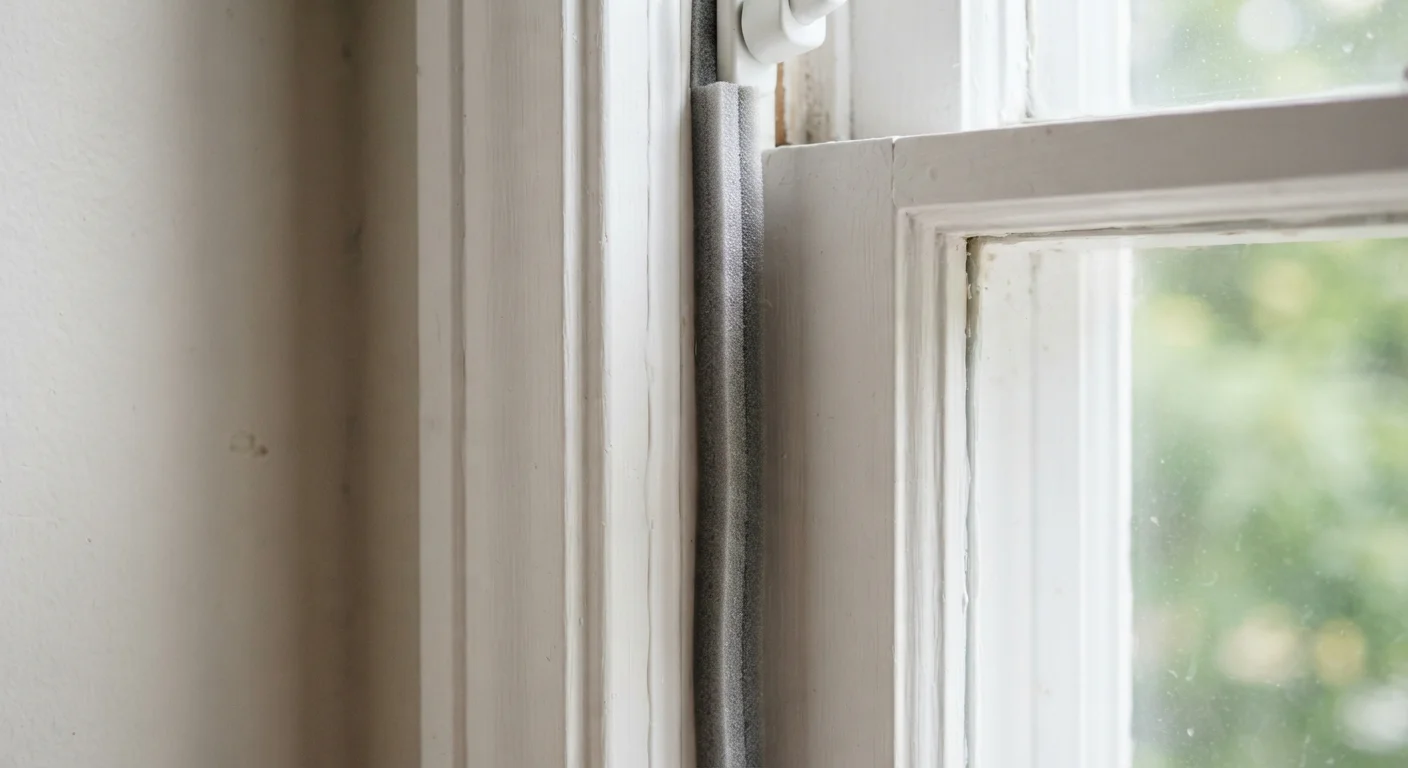
- V-strip (tension seal): A folded strip of metal or plastic that springs open to fill a gap. Durable and nearly invisible once installed - a good choice for the sides of double-hung windows and door stops.
- Door sweeps: Attach to the bottom of a door to seal the gap between the door and the threshold. Available in rigid or flexible versions.
- Felt: Low cost, but not weather-resistant. Suitable for interior doors or low-moisture areas only.
Measure the gap you're sealing before choosing a product thickness. A gap that's too large for the strip won't compress properly; one that's too small won't let the door or window close smoothly. Replace worn weatherstripping when you notice daylight visible at the edges or when drafts return despite the strip being in place.
Using Both Together: The Complete Approach
A single door or window typically needs both materials working in tandem. Consider a standard exterior door: the frame is fixed to the wall - caulk that joint. The door stop (the small strip the door presses against when closed) receives weatherstripping. The threshold gap at the bottom gets a door sweep. Each product is doing the job it was designed for.
The same logic applies to windows. Caulk seals the frame-to-wall joint on all four sides. If the window is operable - a double-hung or casement - add V-strip or foam tape along the sash channels where the moving parts slide or compress.
This layered approach is the reason air-sealing is consistently cited by energy professionals as one of the most cost-effective home improvements available to homeowners. It's also worth understanding how moisture and ventilation interact with your sealing efforts - a tightly sealed home needs adequate ventilation to prevent humidity problems. Our overview of moisture control and ventilation explains how these systems balance each other.
Caulk and Moisture: Don't Seal Out Drainage
When caulking exterior window frames, leave a small gap at the bottom of the frame on the exterior side. This weep gap allows any moisture that gets behind the trim to drain out rather than becoming trapped and causing rot. Sealing all four sides of an exterior frame completely can inadvertently direct water into the wall cavity. Check the manufacturer instructions for your specific window type if you're unsure where to stop the bead.