

Key Takeaways
- Moisture trapped by poor ventilation causes mold, rot, and structural damage over time.
- Attics, bathrooms, and crawl spaces are the three highest-risk zones for moisture buildup.
- Bathroom exhaust fans should vent outside, not into the attic or wall cavities.
- Crawl space venting or encapsulation strategies depend on your climate - one size does not fit all.
- Most ventilation checks and minor fixes are low-cost DIY tasks that prevent far more expensive repairs.
Home Ventilation
Home ventilation is the controlled movement of air through different parts of your house - including attics, bathrooms, kitchens, and crawl spaces - to remove excess moisture, heat, and stale air. Without adequate airflow, humidity builds up inside wall cavities and structural materials, creating conditions that support mold growth, wood rot, and long-term structural damage. Good ventilation doesn't mean letting cold air in; it means giving moist air a clear path out.
Building codes typically specify ventilation ratios - such as 1 square foot of net free vent area per 150 square feet of attic floor space - though the exact requirement varies by climate zone and whether a vapor barrier is present.
Why Moisture Is Your Home's Quiet Adversary
Water damage doesn't always arrive dramatically - through a burst pipe or a flooded basement. More often, it creeps in slowly as moisture vapor, generated by cooking, bathing, breathing, and even the ground beneath your home. When that vapor has nowhere to go, it condenses inside walls, ceilings, and floor systems, feeding mold colonies and softening wood long before any stain appears on a visible surface.
The repair bills that result - replacing rotted roof decking, remediating mold in wall cavities, sistering damaged floor joists - often run into thousands of dollars. Ventilation is the low-cost maintenance practice that intercepts this process early by giving moisture-laden air a consistent exit route.
~50%
of US homes with crawl spaces have moisture issues
Industry estimates from building science organizations suggest roughly half of homes with unconditioned crawl spaces show signs of elevated moisture or wood decay.
$500-$30,000+
Typical cost range for mold remediation
According to home restoration industry data, mold remediation costs vary widely based on the area affected and whether structural materials must be replaced.
1 in 150
Minimum attic vent ratio (sq ft per sq ft floor)
Most US building codes require at least 1 square foot of net free vent area for every 150 square feet of attic floor space without a vapor barrier.
Attic Ventilation: Protecting Your Roof from the Inside Out
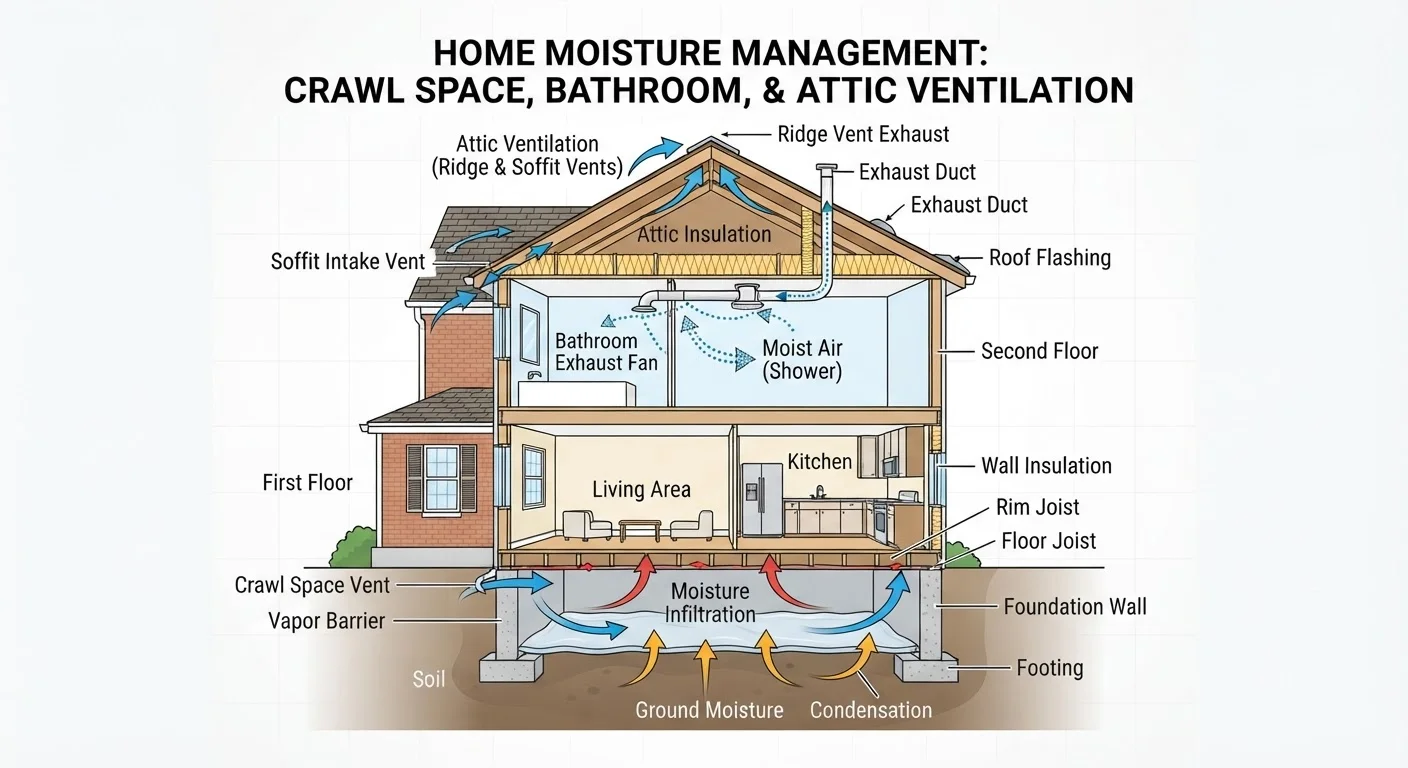
Attics are one of the most moisture-vulnerable spaces in a home, yet they're rarely inspected. In winter, warm air rising from the living space carries humidity into the attic. If that air has nowhere to exhaust, it condenses on cold roof sheathing, soaking insulation and creating the dark staining on rafters that signals early rot. In summer, an unventilated attic can trap superheated air that accelerates shingle degradation from below.
A properly ventilated attic uses two types of openings working together: intake vents (typically soffit or eave vents) that draw cooler outside air in at the low edge of the roof, and exhaust vents (ridge vents, gable vents, or roof-mounted vents) that allow hot, moist air to escape at or near the peak. This passive stack effect moves air continuously without any mechanical help.
The most common DIY mistake is blocking soffit vents with insulation during an attic insulation project. Rafter baffles - inexpensive cardboard or foam channels - keep the airflow path open between the insulation and the roof deck. If you've recently added insulation, it's worth checking that soffit vents are still unobstructed. For guidance on how roof-related moisture problems escalate, see why small roof issues become big repair bills.
Bathrooms and Kitchens: Exhaust Fans That Actually Work
Bathroom exhaust fans are the most straightforward ventilation fix in any home - and one of the most frequently misinstalled. The fan must duct moisture to the exterior of the home, through the roof or an exterior wall. Fans that terminate in the attic or simply recirculate air through a filter do not remove humidity; they relocate it, often directly into roof framing.
Check your existing fan duct by removing the ceiling grille and tracing the flexible duct to its endpoint. If it simply ends above the insulation or connects to a gable vent that isn't sealed, moisture is being dumped into the attic. Extending and properly terminating the duct is typically a manageable DIY project. Also run the fan for at least 15-20 minutes after a shower, not just during it - the majority of moisture lingers in the air after the water stops.
Kitchen range hoods work on the same principle. Recirculating hoods filter grease but do not remove water vapor or cooking-generated humidity. Where possible, choose ducted exhaust over recirculating units.
Test Your Exhaust Fan's Actual Airflow
Hold a single sheet of toilet paper up to the exhaust fan grille while the fan runs. If the paper doesn't cling to the grille, the fan isn't moving enough air - often due to a blocked duct, a failed motor, or undersized fan capacity for the room. Fans are rated in CFM (cubic feet per minute); a general guideline is 1 CFM per square foot of bathroom floor space, with a minimum of 50 CFM.
Crawl Spaces: The Hidden Source of Whole-House Humidity
Ground moisture in an unconditioned crawl space evaporates upward through the soil and into the air below your floor system. Without adequate airflow or a vapor barrier, that humidity travels into floor joists, subfloor sheathing, and eventually the living space above, contributing to musty odors, warped flooring, and wood decay.
Traditional building practice called for open foundation vents on multiple sides of the crawl space to encourage cross-ventilation. Many building scientists and updated codes now favor encapsulated crawl spaces - sealed with a heavy-duty polyethylene vapor barrier on the floor and walls, and conditioned with either a dehumidifier or connection to the home's HVAC system. Research suggests encapsulation can significantly reduce crawl space humidity levels and improve indoor air quality, though the approach requires correct implementation to avoid trapping ground gases.
Before changing your crawl space setup, assess your climate zone and consult local code requirements or a licensed contractor. This is one area where the right solution genuinely varies by region. Pairing crawl space moisture control with good exterior drainage and well-sealed walls goes a long way - see protecting exterior walls from water intrusion for more on that front.
Putting It Together: A Simple Ventilation Maintenance Routine
Preventing moisture damage through ventilation doesn't require specialized tools or a large budget. The core habit is periodic inspection - looking in the right places before small problems become hidden ones.
- Twice yearly: Check attic soffit vents for obstruction by insulation, debris, or bird nests. Confirm ridge or gable vents are unblocked from inside the attic.
- Annually: Trace your bathroom exhaust fan duct from fan to exterior termination point. Verify the exterior vent cap opens when the fan runs and isn't clogged with lint.
- Seasonally: Inspect the crawl space for standing water, condensation on structural members, or signs of pest intrusion that may have blocked foundation vents.
- After any insulation or renovation work: Confirm that no ductwork was pinched, disconnected, or routed incorrectly during the project.
For complementary moisture protection at the building envelope level, weatherproofing your home before winter covers sealing drafts and protecting vulnerable areas before cold weather arrives. Together, smart ventilation and solid air sealing form the foundation of a moisture-resilient home.