

Key Takeaways
- Tail position is one of the clearest indicators of a cat's current mood and confidence level.
- Slow blinking is a well-documented affiliative signal that cats use with trusted humans and other cats.
- Flattened ears and a tucked tail together indicate fear or stress, not aggression by default.
- Context always matters - the same signal can mean different things in different situations.
- Recognizing calm versus stressed body language can help you support an anxious cat more effectively.
- Pain sometimes mimics relaxed stillness; pairing body language reading with other health awareness is important.
Cat Body Language
Cat body language is the system of physical signals - tail position, ear angle, eye shape, posture, and more - that cats use to express their emotional state and intentions. Unlike dogs, cats evolved as both predator and prey, which shaped a communication style that can be subtle and easy to misread. Learning these signals helps owners build trust, avoid accidental stress, and catch early signs of discomfort.
Feline behavioral research distinguishes between agonistic signals (related to conflict or threat) and affiliative signals (related to bonding or friendliness); many body language cues fall along a spectrum between these two states rather than representing fixed meanings.
Why Cat Body Language Is Easy to Misread
Dogs evolved alongside humans for thousands of years and adapted many of their social signals to be legible to us. Cats, on the other hand, spent much of their evolutionary history as solitary hunters. Their communication system is more nuanced, more context-dependent, and more easily missed by owners who are used to reading dogs.
The result is a lot of misread moments: a cat that rolls over isn't always asking for belly rubs; a cat that stares isn't necessarily being aggressive; a slow tail flick is not the same as a happy dog tail-wag. Understanding these distinctions can meaningfully change how you interact with your cat - and how your cat feels about interacting with you. For a broader look at how differently cats and dogs process human communication, see what dogs understand about human communication.
~45
Distinct facial movement combinations studied in cats
A 2023 study published in Behavioural Processes catalogued nearly 45 distinct facial action combinations observed in shelter cats, highlighting the complexity of feline facial communication.
2x
More likely to approach a slow-blinking human
Research by Humphrey et al. found cats were more likely to approach an unfamiliar person who used slow-blink sequences compared to a neutral expression, suggesting the gesture signals safety.
The Tail: Your Clearest Signal
A cat's tail is arguably its most expressive feature, and learning to read it takes you a long way toward understanding the rest.
- Tail high and vertical: Confident, friendly, and comfortable - often a greeting signal directed at a trusted human or companion animal.
- Tail low or tucked: Anxiety, fear, or submission. Combined with other tense signals, this cat needs space, not approach.
- Slow, side-to-side swish: Focused attention or mild irritation - not the relaxed wag of a happy dog. If it speeds up, that's a warning to back off.
- Puffed tail: Involuntary fear or arousal response. The cat is not in a state to be approached.
- Tail wrapped around paws while sitting: Contentment and self-containment - a cat at rest with no particular agenda.
Always read the tail alongside the rest of the body. A high tail with flattened ears tells a different story than a high tail with relaxed, forward-facing ears.
Ears, Eyes, and Posture: The Full Picture
The tail is the headline, but ears, eyes, and overall posture fill in the story.
Ears
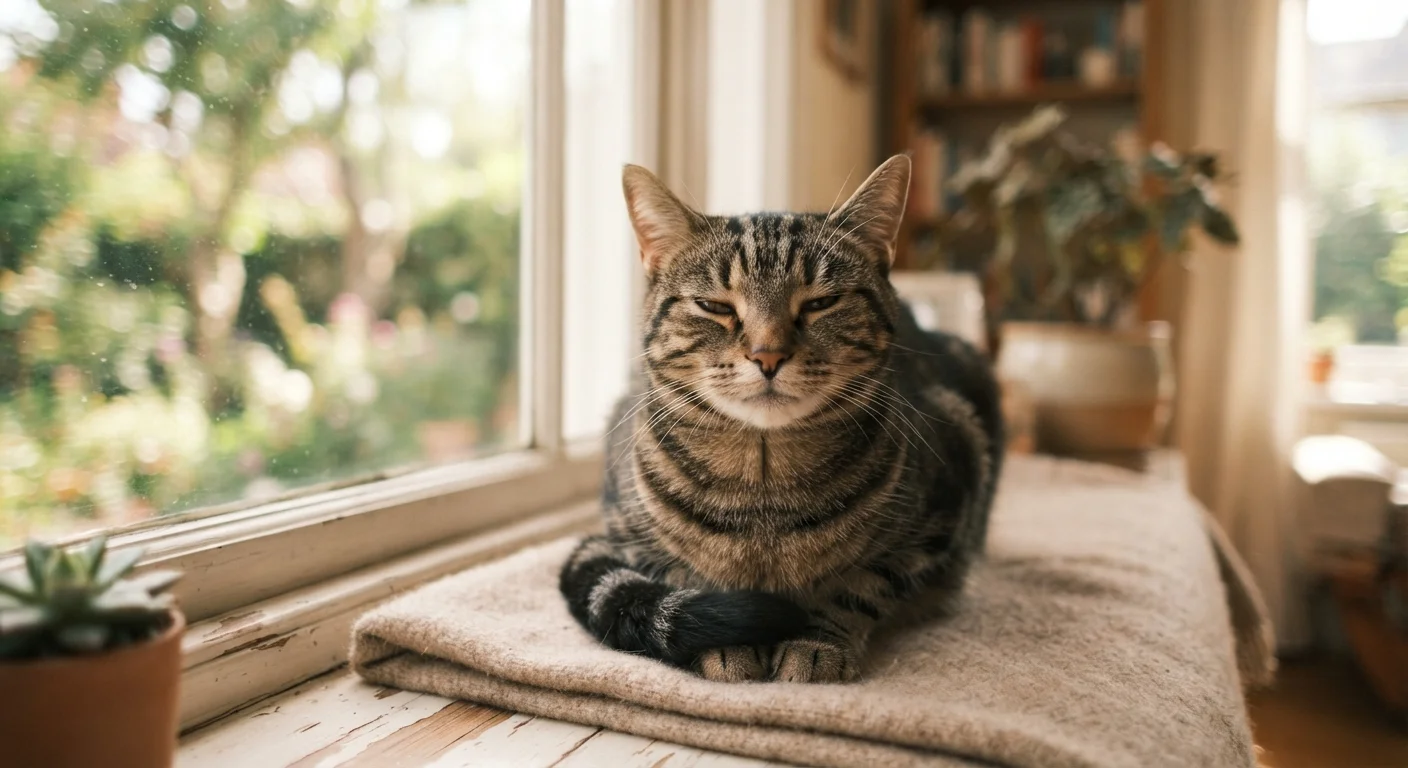
Forward-facing ears signal curiosity and engagement. Ears rotated to the side - sometimes called "airplane ears" - indicate growing anxiety or overstimulation. Fully flattened ears mean the cat feels threatened or is preparing to defend itself.
Eyes
Dilated pupils can indicate excitement, fear, or low light - context determines which. Constricted pupils in bright light are normal, but narrow pupils paired with a hard stare and tense body can signal aggression. Soft, half-closed eyes in a relaxed cat indicate comfort. The famous slow blink - where a cat briefly closes and reopens its eyes - is a recognized affiliative signal that cat owners can gently mirror.
Posture and Position
A cat making itself large - back arched, fur raised, side-on stance - is trying to appear threatening because it feels threatened. A cat crouched low and pressed flat is fearful and trying to disappear. Loose, easy posture with an upright or slightly loafed body position generally signals a calm emotional state.
Try a Slow-Blink Exchange
Next time your cat is relaxed and looking at you, try half-closing your eyes and slowly reopening them. Many cats will respond in kind. It's a low-effort way to reinforce trust, especially with shyer cats who aren't yet comfortable with direct eye contact or touch.
Using Body Language to Support Your Cat's Wellbeing
Reading body language isn't just a fun skill - it has real welfare implications. A cat that regularly shows stressed signals at home may benefit from environmental changes. Our guide on building a low-stress environment for anxious cats walks through practical room-by-room approaches.
Body language is also an important layer in recognizing when something may be physically wrong. Cats instinctively hide discomfort, so behavioral shifts - increased stillness, unusual hiding, or changes in how a cat holds its body - can be among the earliest signs of a health issue. The article on signs your cat may be in pain covers those more specific cues. And if you want a broader look at cat behavior that puzzles many owners, our piece on why cats scratch, yowl, and knock things over is a helpful companion read.
The more fluent you become in your cat's personal signals - because individual cats do have individual communication styles - the stronger your relationship becomes. You'll know when they want company, when they'd rather be left alone, and when something seems off enough to warrant a call to your vet.