

Key Takeaways
- Synthetic fertilizers deliver nutrients quickly but can degrade soil biology over time with heavy use.
- Organic fertilizers release nutrients slowly and build long-term soil health, but results take longer to appear.
- Cost per application often favors synthetics short-term, while organics can reduce inputs over several seasons.
- Environmental runoff risk is generally higher with fast-release synthetic products.
- A blended approach - using both types strategically - is a practical middle ground for many home gardeners.
Our Verdict
Neither fertilizer type is universally superior. Synthetic fertilizers excel when plants need fast correction or a quick seasonal boost, while organics consistently improve soil structure and support a healthier garden ecosystem over time. For most budget-conscious home gardeners, starting with a soil test and layering organic matter into the routine - supplemented by targeted synthetic use when needed - offers the best balance of results and value.
| Best for | Recommended |
|---|---|
| Gardeners who need rapid nutrient delivery or quick problem correction | Synthetic fertilizers |
| Those focused on long-term soil health and lower environmental impact | Organic fertilizers |
| Budget-conscious families who want flexible, season-by-season control | Blended approach (organic base + targeted synthetics) |
| Gardeners composting at home who want to minimize purchased inputs | Organic fertilizers plus homemade compost |
What Sets These Two Fertilizer Types Apart
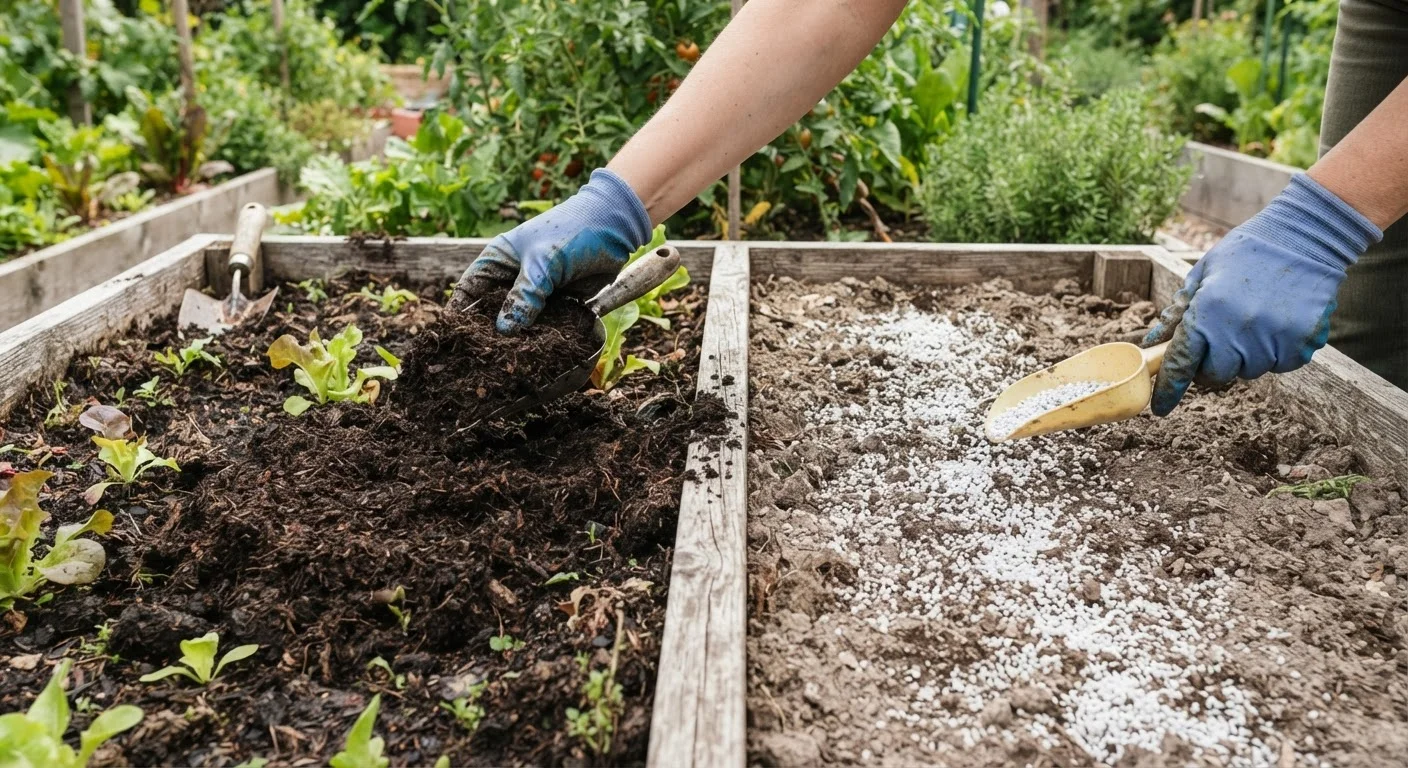
At their core, the difference between organic and synthetic fertilizers comes down to origin and how nutrients reach your plants. Organic fertilizers are derived from natural materials - composted manure, bone meal, blood meal, kelp, and similar sources. They feed soil microbes, which then break down the material and release nutrients gradually into the root zone. Synthetic fertilizers (also called inorganic or chemical fertilizers) are manufactured from mineral salts or industrial processes. Their nutrients are already in a plant-available form, meaning roots can absorb them almost immediately after application.
Both types supply the primary macronutrients plants need - nitrogen (N), phosphorus (P), and potassium (K) - but how quickly, how reliably, and at what environmental cost differs considerably. Understanding those differences helps you match the product to your actual garden situation rather than defaulting to habit or marketing language.
If you're also deciding how your garden is physically laid out, see our guide to raised beds vs. in-ground plots, since soil amendment strategies can vary between the two setups.
Nutrient Release, Speed, and Predictability
Synthetic fertilizers are formulated to deliver precise, consistent nutrient ratios. A bag labeled 10-10-10 contains 10% each of nitrogen, phosphorus, and potassium by weight - a level of predictability that makes dosing straightforward. Fast-release synthetics begin working within days, which is useful for correcting a visible deficiency mid-season or giving transplants an immediate boost.
Organic fertilizers are less predictable in their release timing. Nutrient availability depends on soil temperature, moisture levels, and microbial activity - all of which vary by season and climate. In cool spring soil, breakdown slows and plants may not receive the full benefit right away. This is a genuine limitation when you need a fast fix.
However, that slow-release quality is also an advantage: nutrients are less likely to wash out before roots can absorb them, meaning less waste and more efficient use over the growing season.
| Organic Fertilizers | Synthetic Fertilizers | |
|---|---|---|
| Nutrient release speed | Slow, season-long release | Fast, often within days |
| Soil biology impact | Feeds and builds microbial life | Neutral to negative long-term |
| Predictability of nutrient ratios | Variable by source and conditions | Consistent and clearly labeled |
| Typical upfront cost | Higher per application | Lower per application |
| Runoff and leaching risk | Lower (slower release) | Higher (especially fast-release types) |
| Ease of use | Requires more planning ahead | Simple, measure-and-apply |
| Long-term soil improvement | Yes - adds organic matter | No - does not add organic matter |
Soil Health and Long-Term Effects
This is where organics hold a clear edge. Organic matter - whether from compost, aged manure, or plant-based meals - feeds the microbial communities in soil. Those microbes improve soil structure, enhance water retention, and make a broader range of nutrients available over time. Repeated use of organic amendments tends to build what gardeners call "living soil," which becomes progressively more productive.
Heavy or repeated synthetic fertilizer use, by contrast, does not contribute organic matter. Over many seasons, soils fed primarily with synthetics can become compacted and biologically depleted, requiring ever-larger inputs to maintain yields. This isn't a reason to avoid synthetics entirely, but it does argue for not relying on them exclusively.
If you're interested in building soil fertility without buying anything, backyard composting is worth evaluating alongside fertilizer strategies - it can meaningfully reduce how much purchased product you need. You can also find a practical how-to in our guide to composting at home.
Start With a Soil Test Before You Buy Anything
A basic soil test - often available for a modest fee through your local cooperative extension service - tells you exactly which nutrients are deficient and what your soil's pH is. Without this baseline, you risk over-applying certain nutrients while missing others entirely. Testing first means you spend money only on what your garden actually needs, which is the most budget-conscious approach regardless of whether you choose organic or synthetic products.
Cost, Environmental Impact, and Practical Trade-Offs
Per-pound of nutrients, synthetic fertilizers are typically less expensive upfront than organic alternatives. For a gardener on a tight budget who needs to fertilize a large area quickly, that cost difference is real. Organics - especially certified products or bagged specialty amendments - can carry a significant price premium.
The environmental picture complicates the cost calculation. Synthetic fertilizers, particularly fast-release nitrogen formulations, carry a higher risk of nutrient runoff into waterways when over-applied or applied before heavy rain. This can contribute to water quality problems downstream. Organic fertilizers release more slowly, reducing but not eliminating runoff risk.
~50%
Nitrogen lost to runoff or volatilization
Research published by university extension programs estimates that roughly half of applied synthetic nitrogen can be lost before plant uptake under poor application conditions.
3-4 weeks
Typical wait for visible organic fertilizer results
Gardening educators commonly cite a 3-4 week lag for slow-release organic products, depending on soil temperature and moisture levels.
A practical middle path many experienced gardeners use: build a soil foundation with organic matter (including homemade compost where possible), then use small, targeted applications of synthetic fertilizer when a specific deficiency needs fast correction. Always start with a soil test - available through most cooperative extension services - so you're adding only what's actually missing rather than guessing.
For gardeners interested in reducing overall garden inputs, pairing fertilization with smart mulching can help retain moisture and moderate soil temperature. See our overview of mulch types and their uses for a practical breakdown.